

The best AI books in 2026 teach you to build something that still works after the next model release. That rules out most of the shelf, since a title from 2024 is often explaining a stack that has been renamed twice since.
Five books clear the bar. Each leaves a reader able to build or decide something real at work, and each explains enough of the why that its lessons outlast its code samples. This list is for people who build with AI, from a first script to a production system.
Every entry below says what it does that the other four do not, and where it falls short.
How we ranked the best AI books
Every book was measured against the same four criteria, with the same weights, and none got credit for its publisher or its price. The field is limited to books you can buy, so titles whose full text is free online were left out.
| Criterion | Weight | What it actually measures |
|---|---|---|
| Transfer | 35% | Whether what you learn survives a new model, provider or framework |
| Currency | 25% | How much of it describes building with AI as the work is done in 2026 |
| Practical payoff | 25% | What you can build or decide at work the week you finish it |
| Mechanism | 15% | Whether you can explain why a technique works |
Transfer carries the most weight because the model names in all five of these books will be wrong within a year, and the library versions sooner. The part worth paying for is the part you can carry into a stack the author never saw.
The weights decide the top of the list. Shift them toward mechanism and second place takes first.
1. Agentic AI Engineering, by Hyun Erwin
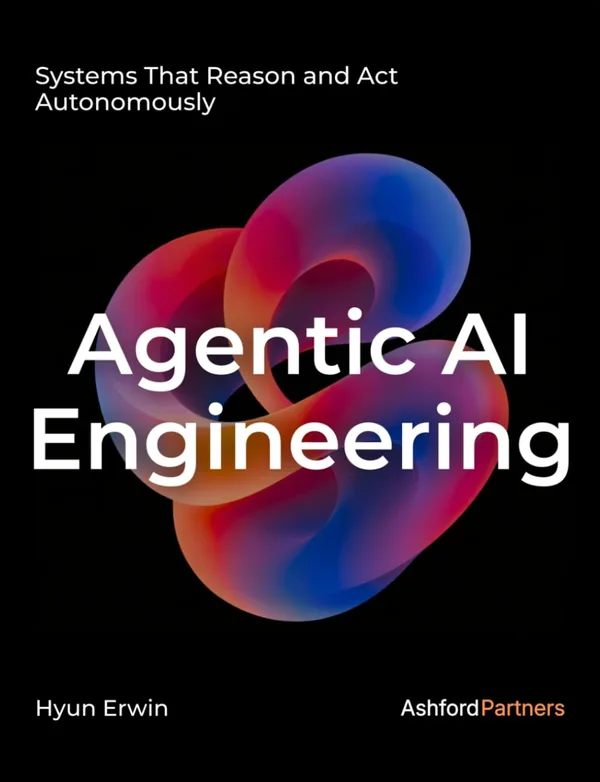
Agentic AI Engineering is an Ashford Partners title from March 2026, at 333 pages across 43 modules. Erwin is an IT consultant with a background in data science and security, and the book assumes basic coding.
The first half explains how an agent works, up to tool design. The second half builds two complete systems in Python: an assistant confined to one folder, then a coding system where one agent plans and a read-only agent grades every result.
Both systems are explained in depth, with no framework beyond LiteLLM, so changing providers means editing a string. A worked cost example shows a ten-step agent loop reading about 28,000 input tokens for a task one direct call handles in roughly 1,500. Most teams learn that ratio from an invoice.
It holds first on transfer and currency, and gives ground elsewhere. As an agents book, it leaves the wider map of AI engineering to second place, which also goes deeper on mechanism. Its evaluation and operations chapters are prose, with no tests or tracing added to either system. The Model Context Protocol, the open standard for connecting agents to tools, gets a full module and sits out both builds, and third place wires it up in code.
For prompts and model training in one binding, see the combined AI Engineering volume from Ashford, a different book from second place despite the shared title.
This book is published by Ashford Partners.
2. AI Engineering, by Chip Huyen
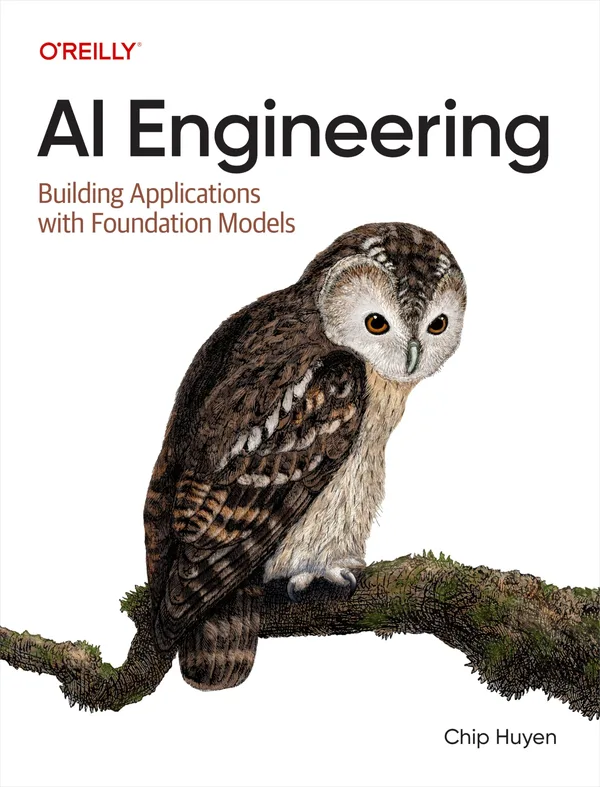
Huyen taught Machine Learning Systems Design at Stanford and has worked at NVIDIA and Snorkel AI among others. Her 532-page O'Reilly book came out in January 2025, rated intermediate to advanced.
It covers building applications on foundation models somebody else trained. Evaluation gets two chapters before any technique does, and the techniques then arrive in rough order of cost, starting with prompt engineering and ending with fine-tuning. Dataset engineering and inference optimization follow.
What sets it apart is judgment. It is the best book available on deciding which technique a problem needs. When someone proposes fine-tuning in a planning meeting, this book hands you the cheaper options to try first and the evaluation that proves which one worked.
It lands second, and the gap to first is the calendar and the keyboard. It went to print before agents became the default way to build, with RAG and agents sharing a single chapter, a thin slice of what is now the busiest area in the field. Huyen's own repository for the book says plainly that it is not a tutorial and has few code snippets, so you finish knowing what to build and still have to build it. Weight mechanism above currency and this book wins the list.
3. AI Agents in Action, Second Edition, by Micheal Lanham
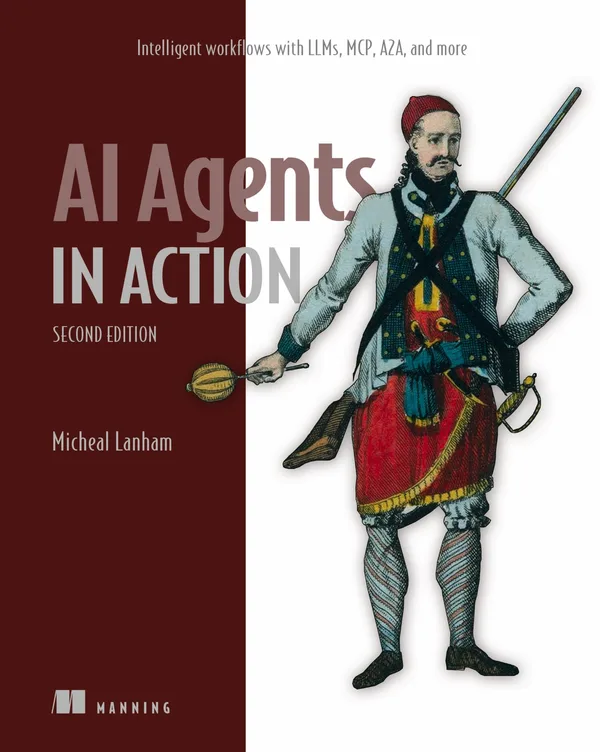
Lanham has more than 20 years in software and wrote Manning's Evolutionary Deep Learning. His second edition arrived in July 2026 at 391 pages, and Manning says more than 95 percent of it was rewritten.
It climbs from a first agent to multi-agent workflows, with tool use over MCP and memory among others along the way. Later chapters carry those agents through evaluation and deployment. It is written for intermediate Python programmers with no agent experience.
What sets it apart is MCP in practice. The third chapter connects an agent to real tool servers through the protocol, with working code in the book's repository. If your next job is wiring an agent into a company's systems, this is the book that shows how.
It lands third on transfer. Its sample code repository builds on the OpenAI Agents SDK and notes that every example needs an OpenAI API key. The same README pins the MCP library below version 2.0, because version 2 removed a class its MCP servers are built on, which is this whole criterion in one line of setup notes.
4. Hands-On Machine Learning with Scikit-Learn and PyTorch, by Aurélien Géron
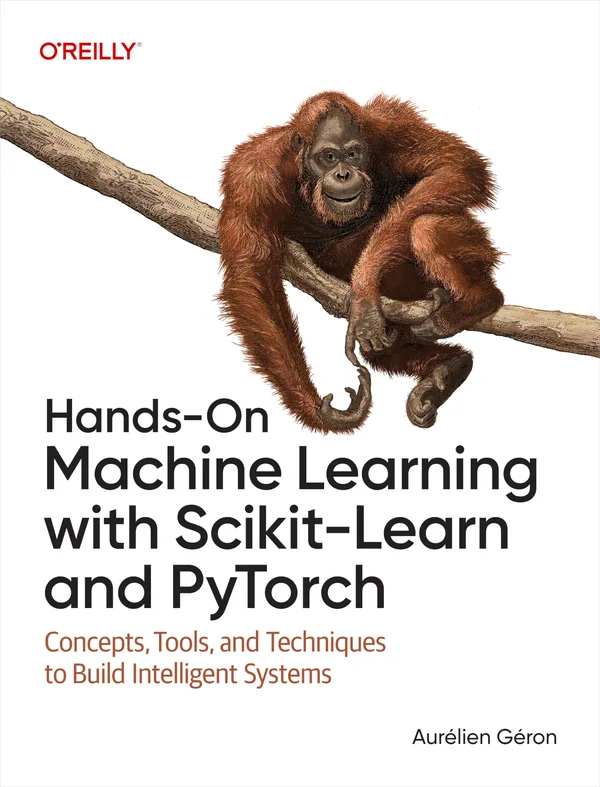
Géron led YouTube's video classification team at Google from 2013 to 2016 and now works as a machine learning consultant. This PyTorch edition of his long-running series came out from O'Reilly in December 2025, at 875 pages.
Part one covers classic machine learning with scikit-learn, from a first end-to-end project through to unsupervised learning. Part two moves to neural networks in PyTorch and keeps going through transformers and diffusion models among others, as the table of contents on O'Reilly shows.
What sets it apart is range. It is the only book here that starts at linear regression, and the classic methods it teaches still solve plenty of production problems. Sometimes the right model is a random forest, and this is the only book on the list that will introduce you.
It lands fourth on currency and payoff. Transformers arrive in chapter 15 of 19, after hundreds of pages of methods many application builders will never train, and its agents are the reinforcement learning kind, which share a name with first and third place and little else. At 875 pages it is a semester of reading. The call against third place is close, since this book wins on mechanism and transfer.
5. Build a Large Language Model (From Scratch), by Sebastian Raschka
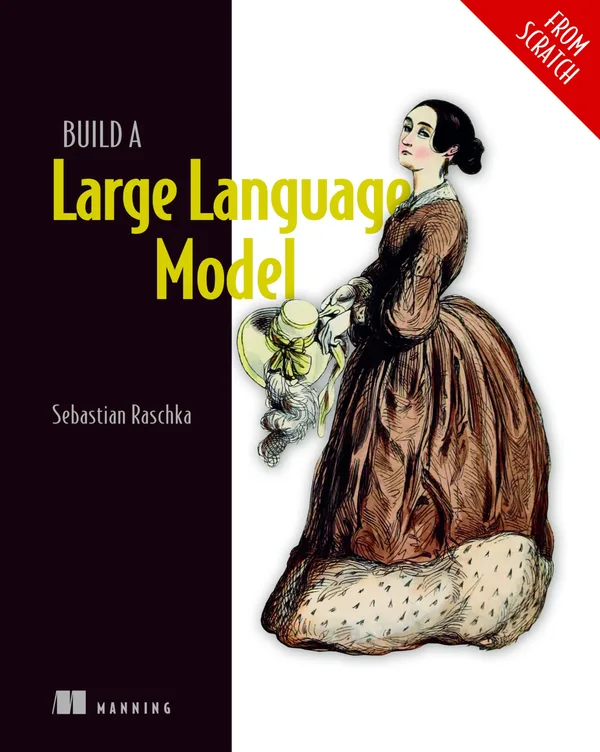
Raschka works on LLM research and open-source software. His 368-page Manning book from October 2024 has you code a GPT-style model that runs on an ordinary laptop, and it expects intermediate Python plus some machine learning.
You implement attention and assemble a full model around it, with diagrams at each stage so the architecture is on the page before it is in your editor. Later chapters load pretrained weights and fine-tune the model, first as a text classifier and then to follow instructions.
What sets it apart is that no LLM library stands between you and the model. Next time someone says a model "attends" to a word, you will know which matrix multiplication they mean, and that understanding survives any change of vendor.
It lands fifth on currency and practical payoff. It went to print in October 2024 and ends at a fine-tuned model comparable to GPT-2, a teaching artifact few readers will ever ship. Most people building with AI in 2026 call a hosted model, and the book stays below that layer on purpose. Read it for understanding, and budget for a second book to put the understanding to work.
Which AI book to read first
The ranking says which book is strongest on the criteria. This table matches each one to the problem on your desk.
| If you are | Start with |
|---|---|
| Building your first agent, or replacing a framework you outgrew | Agentic AI Engineering |
| Choosing between prompting, RAG and fine-tuning for a product | AI Engineering |
| Wiring an agent to company systems through MCP this quarter | AI Agents in Action, Second Edition |
| New to machine learning and ready to spend a semester on it | Hands-On Machine Learning with Scikit-Learn and PyTorch |
| Curious what happens inside a language model | Build a Large Language Model (From Scratch) |
If you buy two, take first and second place together. One teaches you to build an agent and the other teaches you to decide whether you need one.
For a single shelf in more depth, see the best books on AI agents or the best AI engineering books. For model internals, see the best books on LLMs.