

The best books on AI agents in 2026 are the ones that survive a framework release. That is a harder bar than it sounds. This shelf turns over roughly every nine months, and a title published in 2024 is often still teaching an SDK that has been deprecated twice since.
Five books clear it. They are ranked below from first place to fifth, each with the thing it does that the other four do not, and the place where it runs out of road.
How we ranked the best books on AI agents
Every title was measured against the same four questions. No book got a bonus for its publisher or its price. The field is limited to books you can buy.
| Criterion | What it actually measures |
|---|---|
| Lifecycle coverage | How much of the road from first prototype to a system on call it walks with you |
| Currency | Whether it covers the 2026 plumbing, including MCP and agent-to-agent messaging |
| Runnable code | Whether the examples execute, or only illustrate |
| Shelf life | How much of the book is still true after the framework it uses ships a breaking change |
Shelf life carries the most weight, which is deliberate. The Model Context Protocol, meaning the open standard for wiring a model to tools and data, went from a curiosity to table stakes in about a year. Any agent book that predates it is missing the plumbing most 2026 systems now sit on.
1. AI Agents in Action, Second Edition, by Micheal Lanham
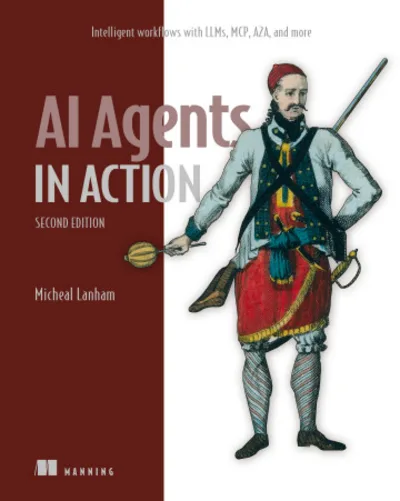
Lanham's second edition landed in June 2026 at 392 pages, and it is the most complete single volume on this shelf. The subtitle names the plumbing directly, with MCP and agent-to-agent messaging on the cover.
The book is organised around five functional layers that every agent has, whether or not its author noticed:
- Persona
- Actions and tools
- Reasoning and planning
- Knowledge and memory
- Evaluation and feedback
What sets it apart is that this is a diagnostic frame. When an agent starts calling the same tool forty times in a row, you are looking at a reasoning-and-planning failure, and knowing that saves you a day of rewriting the system prompt at the wrong layer. Object permanence remains, apparently, a premium feature.
Everything else is there too, from typed outputs and the OpenAI Agents SDK through to observability and deployment. The code runs. It takes an intermediate Python programmer with no agent experience and leaves them somewhere real.
One caveat, and it is the warning label for this entire category. The first edition was excellent and aged in about twelve months. Buy the second edition, and assume a third is coming.
2. Agentic AI Engineering, by Hyun Erwin
Agentic AI Engineering runs 333 pages and opens on the distinction most teams get wrong, which is how an autonomous system differs from an automation. From there it works through reasoning loops and core components into system prompt design, and then spends the bulk of its length building single- and multi-agent systems in Python.
What sets it apart is the spine. Lanham organises his book by functional layer, and Gullí, in fifth place, organises his by pattern. This one organises by the system you are building, walking a single agent up from its reasoning loop before putting several of them to work together, in code, at length. It is also close to framework-agnostic, so a breaking change upstream costs you a code sample instead of a chapter.
It lands second on the narrowest margin on this list. Lanham's five-layer model is what separates them, because it doubles as a debugging index: when an agent misbehaves, you have a named place to look first. That is an organising advantage over this book and not a gap in what it covers, and a reader who is building more than diagnosing could reasonably flip the two. Staying framework-agnostic cuts both ways as well, since a team already committed to LangGraph will be translating as it reads. If the problem is operating a fleet in production instead of building one, third place has more for you.
Readers who want prompts and model training in one binding should look at the combined AI Engineering volume instead. Readers on the business side of the same question want Agentic AI in Business, which is a different book for a different meeting.
This book is published by Ashford Partners.
3. Building Applications with AI Agents, by Michael Albada
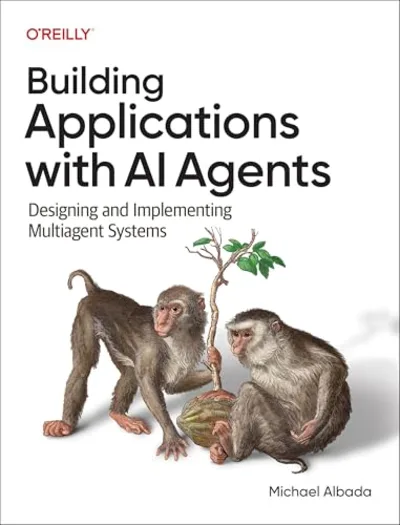
Albada built large-scale machine learning systems at Uber and Microsoft among others, including multi-agent systems for cybersecurity, and it shows in what he chooses to worry about. His 352-page O'Reilly title arrived in October 2025 and is subtitled "Designing and Implementing Multiagent Systems," which is the honest description of its centre of gravity.
It walks the core components, then tours the major AI agent frameworks, then spends real page count on coordination patterns and scalability. Security and evaluation each get a chapter of their own, as does human-agent collaboration.
What sets it apart is that it treats a multi-agent system as a distributed systems problem with a language model inside, which is what one is. The security and evaluation chapters read like they were written by someone who has been paged at a bad hour, because they were.
It lands third for one structural reason: the framework tour is the fastest-ageing content in any agent book, and this one has a lot of it. The chapters on LangGraph and CrewAI among others were accurate when they went to print and are already drifting. It is also less patient with a reader who has never built an agent, which is fine if you have and painful if you have not.
4. Principles of Building AI Agents, by Sam Bhagwat
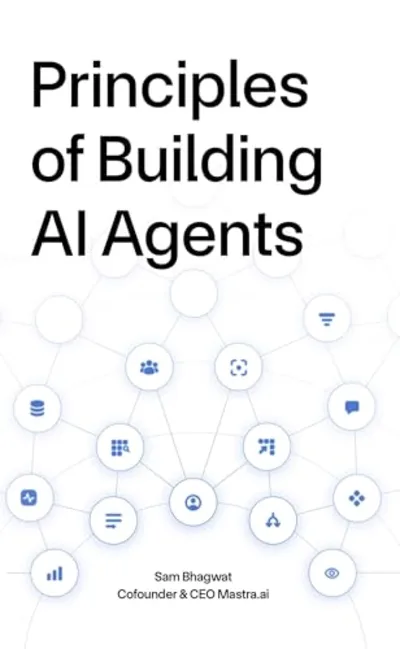
Bhagwat is the cofounder and CEO of Mastra, and his book is now in its third edition with more than 189,000 copies printed. It is free, it is 34 short chapters, and it is the fastest route on this list from knowing nothing to having an agent that answers.
It starts at LLM fundamentals and prompt engineering, then moves through tool calling and memory into workflows and retrieval, and finishes on multi-agent systems and deployment. The later editions added MCP and agent-to-agent messaging among others, so it is genuinely current.
What sets it apart is the language. Every other book here assumes Python. This one is TypeScript-first, which makes it the only serious option for the large population of engineers whose production stack has never had a virtualenv in it.
It lands fourth because the framework is the spine. Mastra's API is how the concepts are delivered, so separating a durable idea from a library call is homework the reader has to do alone. That is a fair trade for a free book written by the people shipping the thing, and it is still a trade.
5. Agentic Design Patterns, by Antonio Gullí
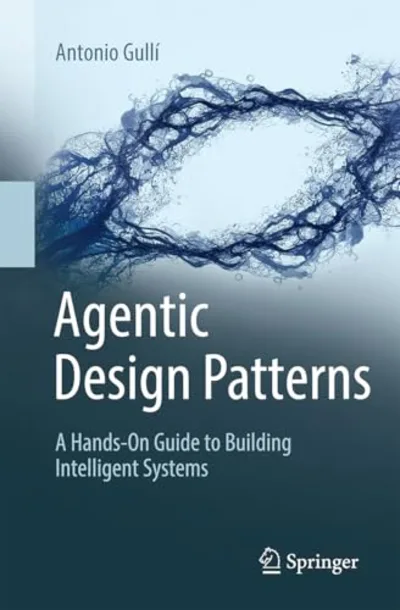
Gullí is a Senior Director and Distinguished Engineer in Google's CTO office, and his 427-page Springer volume does one job extremely well: it gives you names for things. Twenty-one agentic design patterns across four parts, each with a definition and working code.
The patterns cover ground most teams reinvent badly:
- Prompt chaining and routing
- Reflection and planning
- Multi-agent collaboration and inter-agent communication
- Memory management and knowledge retrieval
- Model Context Protocol and tool use
- Guardrails and human-in-the-loop escalation
- Evaluation and monitoring, among others
What sets it apart is the vocabulary. Once your team can say "that is a routing problem, we are treating it as a planning problem" in a standup, the argument gets forty minutes shorter. Gullí also publishes the full draft publicly, and states that 100 percent of his author royalties go to Save the Children International.
It lands fifth because a catalogue is a lookup structure. You can finish all 21 patterns and still have no idea which three you need on Monday morning, which is the same feeling as owning a very good dictionary and being asked to write a novel. The operational half, meaning cost and latency among others, gets less room than the design half.
Which AI agent book to read first
The ranking answers "which is best." It does not answer "which is best for you this week," so here is that instead.
| If you are | Start with |
|---|---|
| New to agents, want one book | AI Agents in Action, Second Edition |
| Building your first multi-agent system in Python | Agentic AI Engineering |
| Operating a multi-agent system at scale | Building Applications with AI Agents |
| A TypeScript shop, or short on budget | Principles of Building AI Agents |
| Looking for shared vocabulary for a team | Agentic Design Patterns |
Two of the five can be read at no cost, so the price of being wrong about this is a weekend. That is a better deal than the category usually offers, and it is worth taking before the next SDK release makes half of this list a historical document.
If you would rather start from the problem than from the shelf, our piece on building agentic AI applications with a problem-first approach covers the step every one of these books assumes you have already done. For a view of who is selling what in this market, see the map of agentic AI companies.