

The best books on LLMs in 2026 are the ones that open the model up and show you the arithmetic inside. Plenty of titles teach you to call a large language model through somebody's API. Far fewer explain why it picks the next token it picks, or what it takes to train one, and those are the five ranked here.
The bar was the same for all of them. A reader had to finish able to explain a transformer in their own words, and four of the five had to leave that reader able to change one.
The list counts down from fifth place to first. Every entry says what it does that the other four do not, and where it runs out of road.
How we ranked the best books on LLMs
Every book was measured against the same four criteria, with the same weights. None got credit for its publisher or its price.
| Criterion | Weight | What it actually measures |
|---|---|---|
| Mechanism | 40% | Whether you finish able to explain, and ideally write, what happens between the prompt and the next token |
| Training coverage | 25% | How much of the path from raw text to a tuned model it walks you through |
| Currency | 20% | How much of it describes how models are built and adapted in 2026 |
| Reach | 15% | How wide a range of readers can finish it and use what they learned |
Mechanism carries the most weight because it is the part that does not expire. Libraries get deprecated and model families get renamed, and a reader who understands attention can still read next year's paper. A book that teaches you a function call teaches you one release of one library.
Disclosure: Ashford Partners publishes one of these five books, LLM Systems Engineering by Rob McKinsey.
5. How Large Language Models Work, by Edward Raff, Drew Farris and Stella Biderman
All three authors are machine learning researchers at Booz Allen Hamilton, where Raff is Director of Emerging AI and Farris is Director of AI/ML Research. Their 200-page Manning book came out in June 2025, and its product page states that no knowledge of machine learning is required.
It follows a prompt on its way into the model and back out as a completion, then turns to why models make errors and how to design around them. The later chapters apply that to agents and question-answering systems.
What sets it apart is who can read it. It is the one book here written for someone with no machine learning background, and it still explains tokens and the training objective accurately enough that the engineers in the room will not wince. It is the book to leave on the desk of the executive who keeps asking whether the model knows things.
It lands fifth on mechanism, the criterion with the most weight. You finish able to describe attention and unable to implement it, and nothing in the book lets you train or change a model yourself. For a reader who wants to build, it covers the first week, and the other four books cover the months after.
4. The Hundred-Page Language Models Book, by Andriy Burkov
Burkov holds a PhD in artificial intelligence and wrote The Hundred-Page Machine Learning Book, which this one follows in format. The hands-on PyTorch edition runs 156 pages and came out from True Positive Inc. in January 2025. Tomáš Mikolov wrote the foreword.
It climbs from language modeling basics to the transformer. The book's site says you code a transformer language model from scratch in PyTorch, with the examples running on Google Colab, and the final technical chapter turns to working LLMs, instruction finetuning included.
What sets it apart is compression. It gets from "what is a language model" to a transformer you wrote yourself in fewer pages than anything else on this list, and you can finish it over a long weekend with a notebook open beside it. The title is also only about 56 pages off, which in technical publishing counts as scrupulous honesty.
It lands fourth on training coverage. The compression that makes it fast leaves little room for what dominates a real training run, meaning the data work and the compute budget. Its table of contents has no chapter on reinforcement learning either, which is where third place spends two of its eight. And a hundred-odd pages at this density ask more of a newcomer than two hundred at fifth place's pace.
3. Build a Reasoning Model (From Scratch), by Sebastian Raschka
Raschka is an LLM research engineer who previously taught statistics at the University of Wisconsin-Madison. His 440-page Manning book on reasoning models shipped in June 2026, which makes it the newest competitor on this list.
It starts from a pretrained Qwen3 model and a verifier that checks its maths answers. From there it improves the model's reasoning twice: first at inference time, through sampling and self-refinement, then in training, through reinforcement learning with GRPO, a method that scores a group of the model's answers against each other. It closes on distillation, meaning training a small model to imitate a larger one's reasoning.
What sets it apart is that it covers the layer of LLM work that moved most in the past two years. Reasoning models, meaning models trained to work through a problem before answering, now sit at the top of the market, and this is the only book here that has you build the machinery behind one. Watching a small model learn to check its own arithmetic is oddly moving, in the way a toddler stacking blocks is.
It lands third on training coverage. The book begins with a model somebody else pretrained and stays inside one stage of the pipeline, post-training for reasoning, on maths problems a script can mark. Pretraining and data preparation sit outside it, as does any task without a checkable answer. On currency it beats both books above it, and if reasoning is your day job it should be your first purchase.
2. LLM Systems Engineering, by Rob McKinsey
LLM Systems Engineering is a 2026 Ashford Partners title of 359 pages, organised as 42 modules in eight chapters. McKinsey is a research scientist, and the book reads like one: prose first, with the research literature cited as it goes.
The first chapter works inside the model, following text into tokens and through the transformer. The remaining seven follow a training project in the order you would run one:
- Strategic and technical planning, including data and compute budgets
- Data engineering
- Training systems and model development
- Fine-tuning
- Continued pretraining
- Training from scratch, in Python with Unsloth
- Evaluation, monitoring and maintenance
What sets it apart is training coverage. It is the only book here that walks the whole path from a budget to a monitored model, and it gives continued pretraining, meaning further pretraining an existing model on new domain text, a chapter of its own. The planning chapter is the one readers rarely find elsewhere: the arithmetic that decides whether a proposed run costs a weekend or a quarter. Our piece on when to build an LLM asks the same question in shorter form.
It lands second, and the gap to first is on mechanism, the heaviest criterion. Raschka has you type every component of a GPT-style model and watch it run. This book explains the same machinery in prose and figures, then does its training work through Unsloth, a library that handles much of the plumbing you would otherwise write yourself. For a reader buying one book to learn how an LLM works, first place is the better buy. Breadth costs depth too, and 42 modules in 359 pages means no single technique gets the line-by-line patience third place gives reinforcement learning.
1. Build a Large Language Model (From Scratch), by Sebastian Raschka
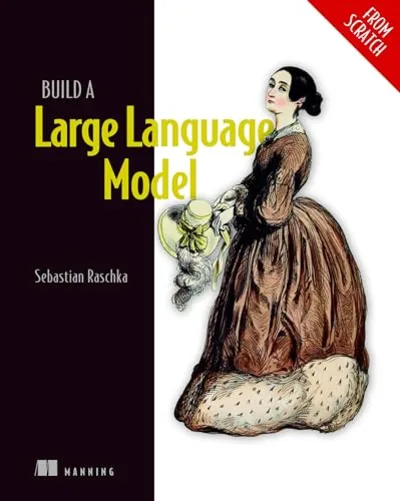
Raschka's first Manning book on the subject came out in September 2024 at 368 pages, and the premise is on the cover. You build a GPT-style model in PyTorch one component at a time, and the main chapters run on an ordinary laptop.
Seven chapters take you from raw text to a working model. Tokenization comes first, then attention, coded in stages until it matches what a production transformer does. The assembled model is pretrained, then fine-tuned twice: once to classify text and once to follow instructions. An appendix adds LoRA, meaning fine-tuning a small set of added weights instead of the whole model.
What sets it apart is that no part of the model stays hidden. The other code-bearing books here each lean on a pretrained checkpoint or a training library at some point. Here the only thing you take on trust is PyTorch, and when the generation loop produces nonsense, the bug is in code you wrote and can read. Your first pretrained model will write like a sleep-deprived autocomplete, and you will be unreasonably proud of it.
It holds first on mechanism, the heaviest criterion, where nothing else here comes close. It loses points on currency. The book is two years old and stops at instruction fine-tuning. The reasoning methods and budget planning covered at third and second place are outside it. If your job is training production models, second place covers more of what you will face on Monday. If it is reasoning, third place is newer.
Which book on LLMs to read first
The ranking says which book is strongest on the criteria. The table below matches each one to the problem on your desk.
| If you are | Start with |
|---|---|
| Explaining LLMs to a team that does not code | How Large Language Models Work |
| After the fastest technical route to a working transformer | The Hundred-Page Language Models Book |
| Working on reasoning, reinforcement learning or distillation | Build a Reasoning Model (From Scratch) |
| Deciding whether to fine-tune or train, then doing it | LLM Systems Engineering |
| Wanting to understand an LLM by building one | Build a Large Language Model (From Scratch) |
Most engineers new to model internals should read first place, then second or third depending on whether their work is training or reasoning. Anyone who needs the concepts without the code can stop at fifth place and miss nothing they will need.
One near miss deserves its name. Hands-On Large Language Models by Jay Alammar and Maarten Grootendorst is excellent on using models, with illustrations that make embeddings click, and it scored below these five because it spends less of itself on training. It appears in our ranking of the best AI engineering books, where application work is the point. Readers who want agents and prompting under the same cover as model training can look at Ashford's combined AI Engineering volume.