

The best AI engineering books in 2026 are the ones you can still use after the stack underneath them moves. That is the whole difficulty with this shelf. AI engineering, meaning the practice of building applications on foundation models somebody else trained, is barely three years old as a named job, and its tooling turns over faster than a print run.
Five titles survive it anyway. They are ranked below from fifth place to first, each with the thing it does that the other four do not, and the place where it runs out of road.
Two of them teach you to build a model and three teach you to build on one, which is most of the purchase decision right there.
How we ranked the best AI engineering books
Every title was measured against the same four questions. No book got a bonus for its publisher or its price.
| Criterion | What it actually measures |
|---|---|
| Lifecycle span | How far past the first working prototype it walks with you |
| Mechanism | Whether it explains why a technique works, or only which function to call |
| Transfer | Whether the lessons survive being lifted out of the book's chosen stack |
| Currency | How much of it still describes how the work is done in 2026 |
Transfer carries the most weight, and that is deliberate. Every stack named in these five books will be partly wrong within a year, so the part worth paying for is the part you can carry into a stack the author never saw. A chapter on why preference alignment changes model behaviour outlives the library that implemented it. Our piece on the AI systems engineering problem covers why that gap keeps reopening.
Disclosure: Ashford Partners publishes one of the five books here, LLM Systems Engineering, at number two. It was scored on the four criteria above like the rest.
5. Hands-On Large Language Models, by Jay Alammar and Maarten Grootendorst
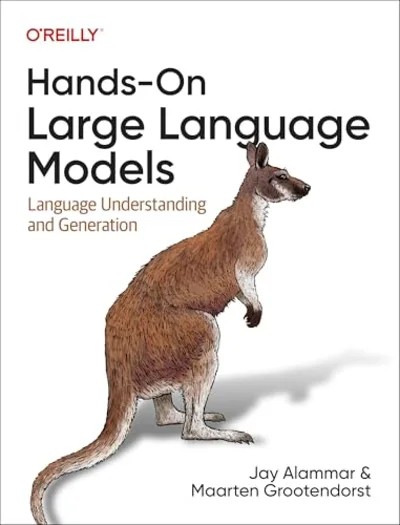
Alammar is a Director and Engineering Fellow at Cohere, and Grootendorst maintains BERTopic and KeyBERT. Their 428-page O'Reilly title arrived in September 2024 with more than 275 custom figures in it, which is the entire pitch and a good one.
It runs from tokens and embeddings through text classification into prompt engineering and semantic search among others. Every chapter is a Python notebook you can run.
What sets it apart is that it teaches by picture. Attention and dense retrieval each get a diagram that does the work three paragraphs of prose would do badly. If you have ever nodded along to an explanation of self-attention while quietly planning to look it up properly later, this is the book that ends that arrangement.
It lands fifth on lifecycle span. The book takes you to a working notebook and stops, so evaluation at any serious level and everything that happens after deployment are somebody else's chapter. Currency costs it too. Written before agents became standard equipment, it describes a 2024 stack accurately and a 2026 one only where nothing moved.
4. LLM Engineer's Handbook, by Paul Iusztin and Maxime Labonne
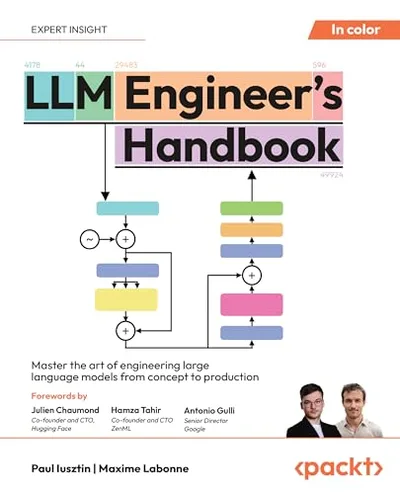
Iusztin is a senior machine learning and MLOps engineer who founded Decoding ML, and Labonne is Head of Post-Training at Liquid AI. Their 522-page Packt handbook landed in October 2024 carrying forewords from Hugging Face and ZenML, which tells you where its sympathies lie.
The book builds one thing across fourteen chapters: an LLM Twin, meaning a model fine-tuned to write in your voice and wired into a real pipeline. Every stage arrives as a step in that single project:
- Data collection into a warehouse
- RAG feature and inference pipelines
- Supervised fine-tuning, then preference alignment with DPO
- Evaluation of the model and of the retrieval separately
- Inference optimisation, quantisation and model parallelism
- Deployment on AWS, autoscaling and LLMOps, among others
What sets it apart is that it refuses to leave you in a notebook. The other four titles explain a technique and move on. This one makes you deploy the thing and then keep it running, which is the stretch where most first LLM projects quietly expire.
It lands fourth on transfer. The LLM Twin is a good teaching vehicle and it is also a very specific application on a very specific stack, with AWS assumed throughout and a named tool for every stage. Lift a chapter out of that context and a good deal of it comes away with the scaffolding attached. The October 2024 date compounds that, since the book is still on its first edition and the tooling it recommends has had two years to move.
3. Build a Large Language Model (From Scratch), by Sebastian Raschka
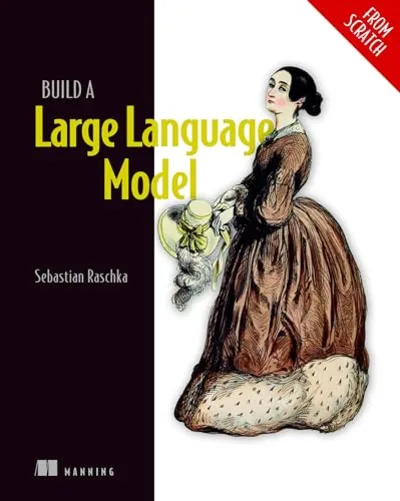
Raschka is an LLM research engineer and a former professor of statistics at the University of Wisconsin-Madison. His 368-page Manning book from September 2024 does exactly what the cover threatens: you type a GPT-style model, one component at a time, until it runs on a laptop.
Attention gets implemented four times over, each version a little closer to what a production transformer does. Then pretraining on a small corpus, then loading the public GPT-2 weights and fine-tuning them for instruction following.
What sets it apart is that nothing stays a black box. The other books tell you what a key-value cache does, meaning the trick that stops a model recomputing its own history on every token. This one has you write one and watch the generation loop speed up. That survives a vendor switch intact, because what you carry away is the mechanism itself.
It lands third on lifecycle span, which is the honest reading of a book that ends at a fine-tuned GPT-2. Serving and the operational half of the job are outside its covers, and the model you finish with is a teaching artefact. Raschka published a companion through Manning in June 2026, Build a Reasoning Model (From Scratch), and it assumes you have already done this one. Budget for two books if the from-scratch route is where you are heading.
2. LLM Systems Engineering, by Rob McKinsey
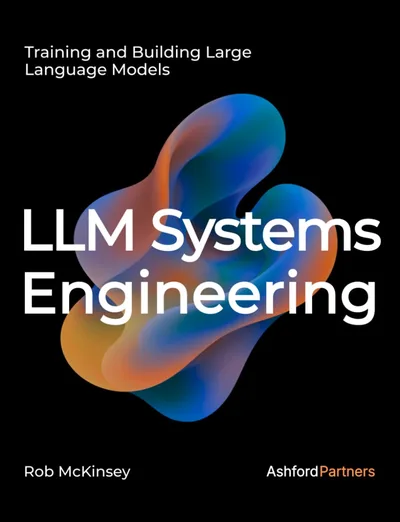
LLM Systems Engineering runs 359 pages across 42 modules in eight chapters, and it opens where a lot of 2026 books stop: inside the model. Tokens and the transformer architecture come first, then pretraining objectives and the inference loop. Only after that does anything get built.
Chapter II is the unusual one: data and compute budgets, meaning the arithmetic that says whether the fine-tune somebody proposed in a meeting costs a weekend or a quarter. From there it runs through data engineering into fine-tuning, and on to continued pretraining and from-scratch training with Unsloth. It closes on evaluation and monitoring.
What sets it apart is that budget lens. Raschka teaches you to build a model and Huyen teaches you to use one. This is the only title here that treats the decision to train as a costed choice with a wrong answer attached. Our piece on when to build an LLM asks it in shorter form.
It lands second, and the gap to first is real. Huyen's book covers the whole application layer this one leaves alone, from evaluating open-ended systems to inference optimisation under load. Most people who say "AI engineering" mean building on somebody's API, and that reader should buy first place first. Third place goes deeper on mechanism too, since Raschka has you type every line where this book will sometimes hand you Unsloth and move on. If you never intend to touch model weights, this is the wrong book on the list for you.
1. AI Engineering, by Chip Huyen
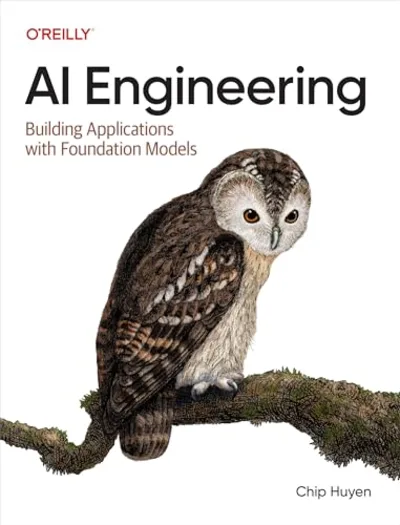
Huyen taught machine learning systems design at Stanford and has worked at NVIDIA and Snorkel AI among others. Her 534-page O'Reilly volume shipped in December 2024, and she reports it was the most read book on the O'Reilly platform in 2025. That is a fair proxy for how badly this field wanted somebody to draw its boundaries.
The order of the chapters is the argument. Evaluation arrives before technique, because the characteristic failure of AI engineering is shipping something nobody can measure. Model adaptation then comes in ascending order of cost:
- Prompt engineering
- RAG and agents
- Fine-tuning
- Dataset engineering
Inference optimisation and application architecture close it out.
What sets it apart is that it is a decision framework wearing a textbook's clothes. Almost none of it is framework code, which is why almost none of it has expired. When somebody announces in a planning meeting that the model needs fine-tuning, this is the book that tells you to try the four cheaper things first and hands you the evaluation to prove which one worked.
One caveat, and it is why first place here is no coronation. The book went to print in December 2024, and its chapter on RAG and agents is now the thinnest treatment of the most active area in the field. Nothing in it is wrong. There is simply a great deal more of it now, and no second edition has been announced.
Which AI engineering book to read first
The ranking answers "which is best." It does not answer "which is best for the thing on your desk this week," so here is that.
| If you are | Start with |
|---|---|
| Building a product on somebody else's API | AI Engineering |
| Deciding whether to train or fine-tune at all | LLM Systems Engineering |
| Trying to understand a transformer by building one | Build a Large Language Model (From Scratch) |
| Shipping a first end-to-end LLM pipeline | LLM Engineer's Handbook |
| Still fuzzy on what any of this actually means | Hands-On Large Language Models |
Four of the five run past 400 pages, so this is not a shelf you clear in a month. Pick the row that matches the decision you are genuinely stuck on and read that one properly. The other four will still be there, in newer editions if you are lucky.
Agents are the one area none of these five covers at full depth, which is why we ranked the best books on AI agents separately. Readers who want agents and model training under a single cover should look at Ashford's combined AI Engineering volume, which shares a name with the book at number one and is a different book entirely.