

The best generative AI books in 2026 cover more than one kind of output. A book that only teaches chat prompts misses the image and video half of the field, and a book that only trains diffusion models leaves you with no idea how to ship an application around one.
Five books clear that bar. Each leaves you able to make a model produce something useful, and each explains enough of the machinery that the skill survives the next model release. The list runs from a builder's handbook to a deep tour of model families.
Every entry says what it does that the other four do not, and where it falls short.
How we ranked the best generative AI books
Every book was measured against the same four criteria, with the same weights, and none got credit for its publisher or its price. The field is limited to books you can buy, so titles whose full text is free online were left out.
| Criterion | Weight | What it actually measures |
|---|---|---|
| Breadth | 35% | How much of the generative stack it covers: text, images and video, agents, and the models underneath |
| Practical payoff | 25% | What you can build or decide at work the week you finish it |
| Currency | 20% | How much of it describes generative AI as it is built in 2026 |
| Mechanism | 20% | Whether you can explain why a technique works |
Breadth carries the most weight because generative AI is now several crafts at once. A product team meets text and image models in the same quarter, then agents in the next, and a book that covers one of them sends the reader shopping for three more.
The weights decide the top of the list. Shift them toward mechanism and the order below first place reshuffles.
1. AI Engineering, by Nelson Ming, Hyun Erwin and Rob McKinsey
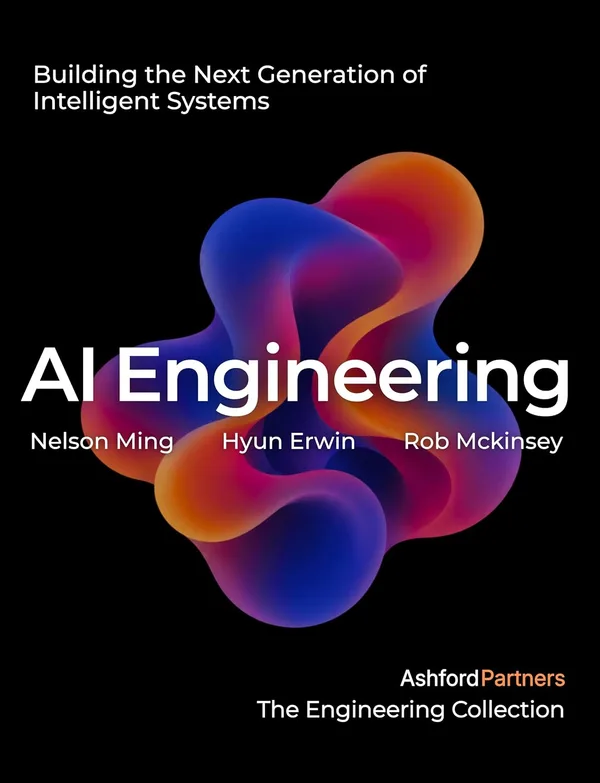
AI Engineering is the Ashford Partners combined edition from August 2026, at 827 pages in paperback. It binds three separate books by three authors into one volume, and each part keeps its own preface and voice.
The prompt book moves from reasoning techniques such as chain-of-thought to five modules on image and video generation. Those explain diffusion at a working level, from the text encoder to the denoising steps, and teach video prompts that split motion into subject and camera layers among others. The agent book builds two systems in Python, ending with a coding team where a read-only verifier grades every worker's output. The model book closes with Unsloth labs that fine-tune Llama 3.1 8B with LoRA on a single 16GB GPU.
No other book here takes a reader from writing an image prompt to adapting the model underneath. It is also candid about its own methods, citing research that multi-agent setups often fail to beat one agent given the same compute.
It holds first on breadth and currency, and gives ground elsewhere. The image and video modules teach prompting and concepts without code, and name no commercial model such as Midjourney or Sora, so third place is the better book for training a diffusion model yourself. Audio and music get no coverage. Three books bound together also repeat themselves, with prompt injection covered twice, while second place argues one thesis more tightly.
Each part also sells alone: AI Prompt Engineering holds the image and video modules, and LLM Systems Engineering holds the training labs.
This book is published by Ashford Partners.
2. AI Engineering, by Chip Huyen
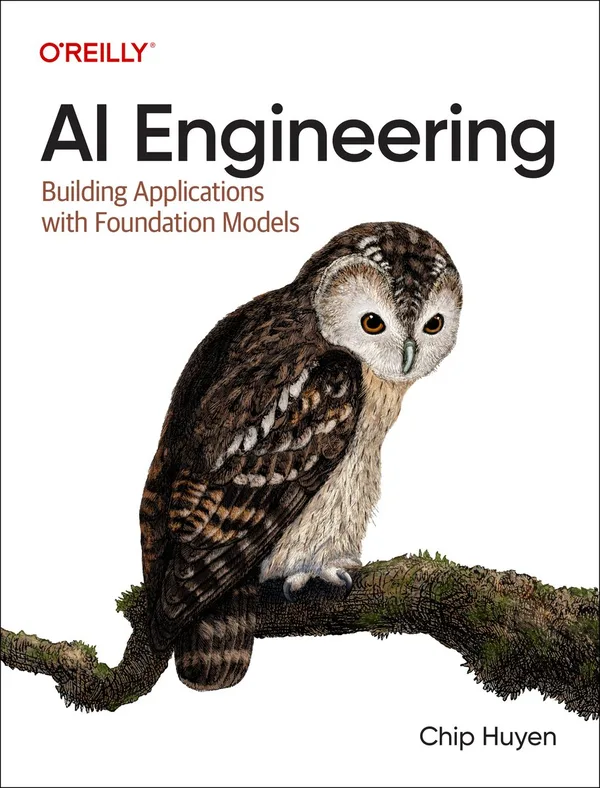
Huyen's AI Engineering came out from O'Reilly in December 2024, at 534 pages. She taught Machine Learning Systems Design at Stanford and worked at NVIDIA and Snorkel AI. Yes, two books on this list share a title. The genre ran out of names some time in 2024, and this one got there first.
It is about building applications on foundation models, the large pretrained models most teams rent through an API. Two full chapters go to evaluation, including the AI-as-a-judge approach, before prompt engineering appears. Later chapters take RAG and agents together, then fine-tuning and inference optimisation.
It is the best book here on deciding what to build, from which model to pick to which metric tells you it worked. Its account of evaluating open-ended output is the most rigorous on the list.
It lands second on breadth. The applications it describes are text-first, and no chapter covers image or video generation. It is organised around decisions more than builds, where first place walks through two agent systems and two training labs in code. On mechanism it is the stronger book, and a reader who only ships text products may reasonably prefer it.
3. Hands-On Generative AI with Transformers and Diffusion Models, by Omar Sanseviero, Pedro Cuenca, Apolinário Passos and Jonathan Whitaker
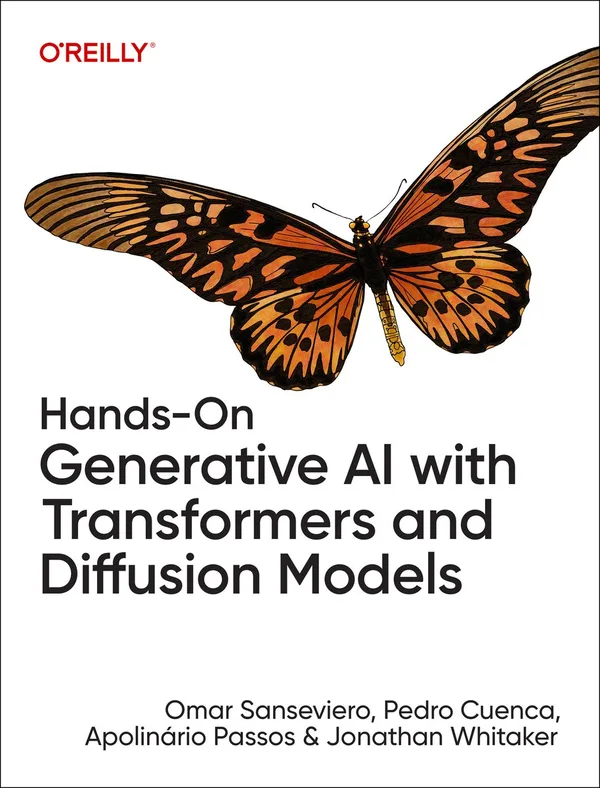
O'Reilly published it in November 2024, at 418 pages, and rates it intermediate to advanced. Four authors wrote it around open models you download and run yourself.
The first part explains transformers and diffusion models, then Stable Diffusion with conditional generation. The second part fine-tunes both language models and Stable Diffusion. A final part reaches creative text-to-image work and audio generation.
It is the only book on the list where you train an image model to reflect your own style, with code at every step. Where first place explains how diffusion works, this one has you open the model and change it. Expect your GPU fan to develop opinions.
It lands third because its range stops at the model. No chapter covers agents or evaluation, and RAG appears only in an appendix. The open-model focus also leaves little on the hosted APIs most products call, which is where first and second place spend their time.
4. Generative Deep Learning, Second Edition, by David Foster
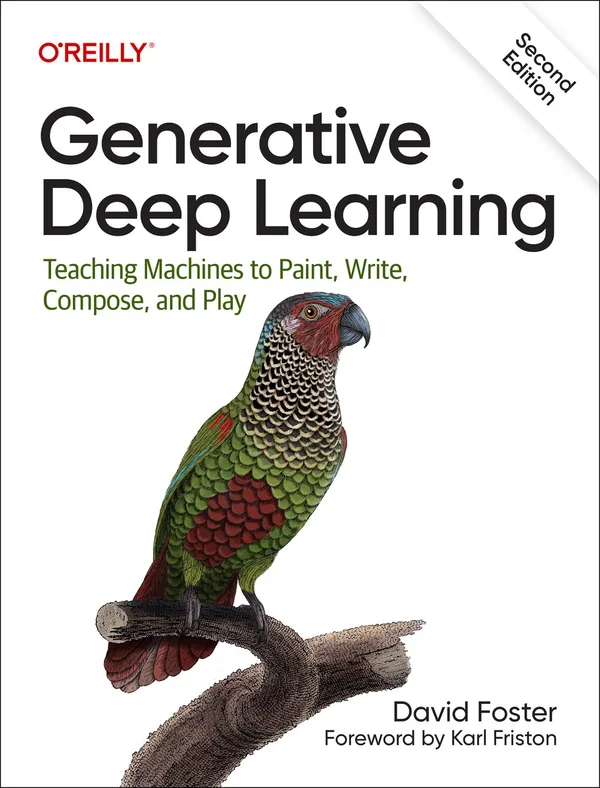
The second edition came out from O'Reilly in April 2023, at 456 pages, with a foreword by Karl Friston. It suits machine learning engineers and data scientists comfortable with Python.
It builds generative models from scratch in TensorFlow and Keras. The tour starts with variational autoencoders and GANs, the generative adversarial networks that pit a generator against a critic, and runs up to diffusion models and a small GPT. It also composes polyphonic music with Transformers and MuseGAN.
It is the widest tour of how machines generate anything, from altered faces to music, and the clearest on why each model family works. Nobody else on this list covers normalizing flows, and nobody else needed to.
It lands fourth on currency. It went to print a few months after ChatGPT arrived, so retrieval and agents, now the daily work of building with these models, get little room. TensorFlow has also lost ground to PyTorch in the open-model world. Read it for the mechanism and take the stack from elsewhere.
5. Generative AI in Action, by Amit Bahree
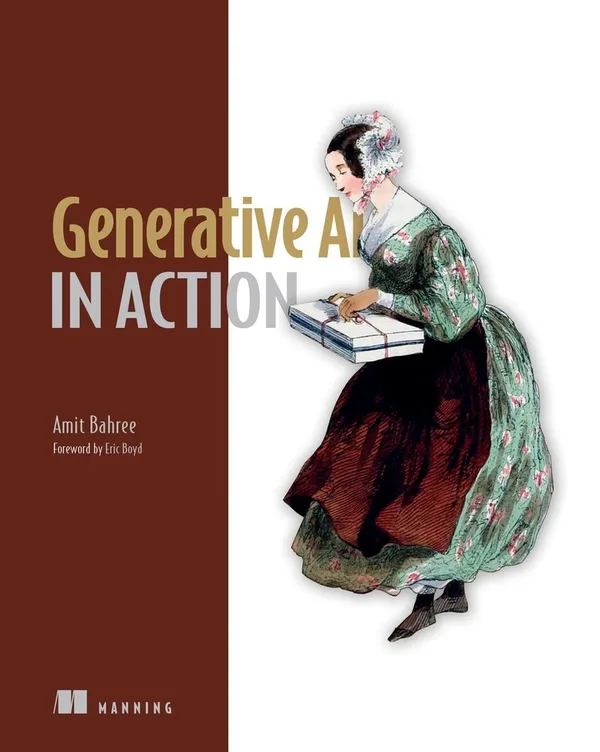
Manning published it in September 2024, at 464 pages. Bahree is Principal Group Product Manager for the Azure AI engineering team at Microsoft, and he wrote it for enterprise architects and developers.
It covers generating text and images, with music as a side trip. From there it moves to prompt engineering and RAG backed by vector databases, then to deploying at enterprise scale with the costs and risks that follow, hallucination and jailbreaks among them.
It is the most enterprise-minded book here, built on real use cases and application architectures. Nobody else on the list prepares you this well for an architecture review board.
It lands fifth on mechanism. By the book's own description it does not dive deep into the science, so a reader finishes knowing what to deploy with less sense of why it works. The call against fourth place is close: weight practical payoff more heavily and the two trade places.
Which generative AI book to read first
The ranking says which book is strongest on the criteria. This table matches each one to the problem on your desk.
| If you are | Start with |
|---|---|
| Building across text, images and agents, and want one book for all of it | AI Engineering (Ming, Erwin and McKinsey) |
| Shipping a text product on a hosted model and choosing how to evaluate it | AI Engineering (Huyen) |
| Training or fine-tuning image models on your own GPU | Hands-On Generative AI with Transformers and Diffusion Models |
| Curious how every family of generative model works | Generative Deep Learning, Second Edition |
| Making the case for generative AI inside a large company | Generative AI in Action |
If you buy two, take first and third place together. One maps the whole field and the other puts a diffusion model on your own hardware.
For a narrower shelf, see the best prompt engineering books or the best AI engineering books.