

The best prompt engineering books in 2026 teach you to write a prompt that still works after the next model upgrade. Most titles on the subject teach phrasing tricks for one chatbot, and those age faster than milk left on a server rack. The five ranked here treat prompting as an engineering discipline: how a model reads what you send it, and how to keep a prompt reliable once real users depend on it.
The bar was the same for all of them. A reader had to finish able to write and test a prompt for a real task, and to explain why it behaves the way it does.
The list runs from first place to fifth. Every entry says what it does that the other four do not, and where it falls short.
How we ranked the best prompt engineering books
Every book was measured against the same four criteria, with the same weights. None got credit for its publisher or its price. The field is limited to books you can buy.
| Criterion | Weight | What it actually measures |
|---|---|---|
| Lifecycle coverage | 35% | How far it follows a prompt past the first draft: testing it, governing it and keeping it working as models change |
| Mechanism | 25% | Whether you finish able to explain why a model responds to a prompt the way it does |
| Currency | 25% | How much of it reflects how models are prompted in 2026, agents included |
| Reach | 15% | How wide a range of readers can finish it and apply what they learned |
Lifecycle coverage carries the most weight because most prompt failures happen after launch. A prompt that passed every check in March meets a new model version in June and quietly starts returning something else. A book that stops at the first draft leaves you alone at the moment the work gets hard.
1. AI Prompt Engineering, by Nelson Ming
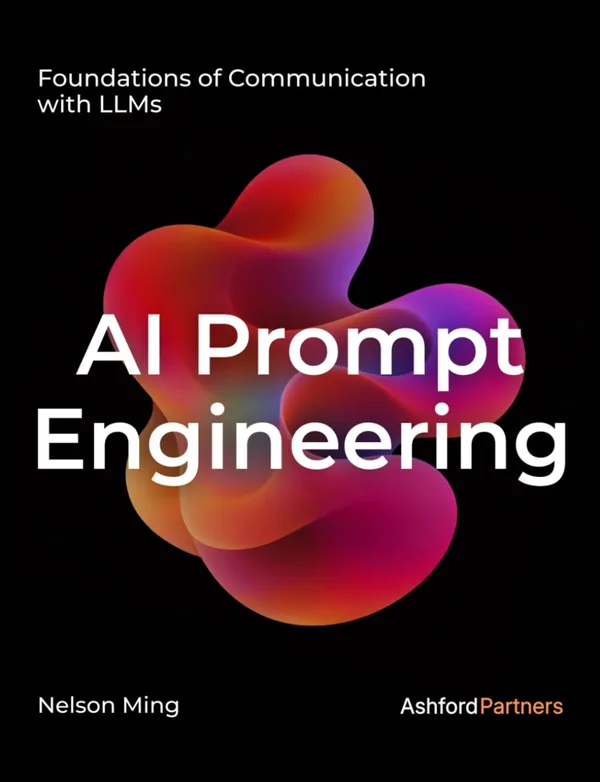
AI Prompt Engineering is an Ashford Partners title published in July 2026, at 353 pages organised as 44 modules in eight chapters. Ming is a computer scientist, and the book assumes no coding or machine learning background.
The first half moves from core techniques to prompting agents, and gives image and video generation a chapter of its own. The second half follows a prompt into production, one chapter per stage:
- Building prompt systems
- Evaluation and testing
- Governance and risk
- Maintenance
What sets it apart is that it follows a prompt past launch. It is the only book here with chapters on governance and on maintenance, meaning the work of keeping a prompt behaving as the model underneath it changes. Your prompt will survive the demo; it is the third model update that gets it. Our guide to building an AI prompt library covers the same habit in shorter form.
It holds first on lifecycle coverage and currency, and it gives ground on mechanism. Its second module explains how a model reads a prompt, from tokenization to the context window, at a working level and without dense mathematics. Second place gives that material two full chapters and returns to it when assembling prompts later in the book, so a reader who wants the deepest account of why a prompt works will still get more from Berryman and Ziegler. It contains no runnable code, which opens it to non-developers and leaves engineers to wire its systems into their own stack. Breadth costs depth too, since image and video share one chapter of eight. And as the newest book here, it has the shortest record of readers testing its advice.
This book is published by Ashford Partners.
2. Prompt Engineering for LLMs, by John Berryman and Albert Ziegler
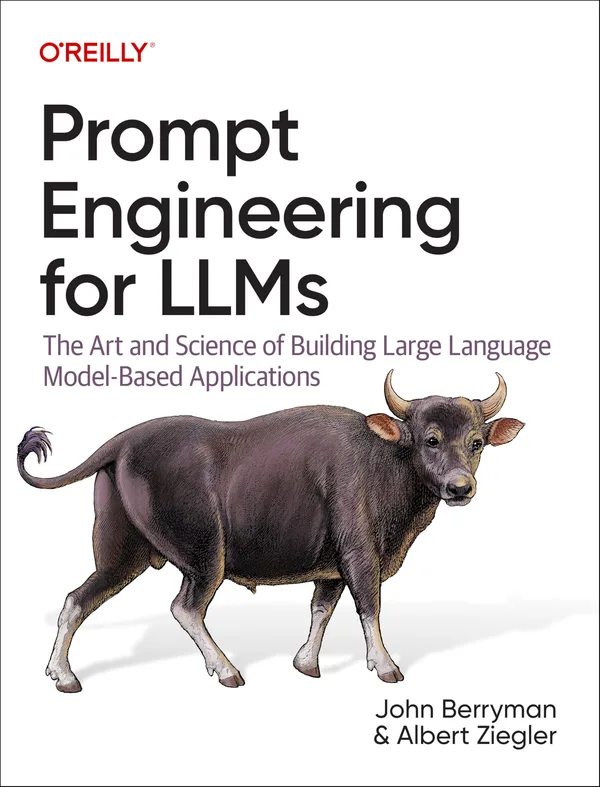
Both authors worked on GitHub Copilot from its early days. Berryman went on to found Arcturus Labs, and Ziegler now leads AI at XBOW, a cybersecurity company. Their 282-page O'Reilly book came out in November 2024.
The early chapters explain how a model sees text, from tokenizers to the move from completion models to chat. The middle chapters assemble a prompt piece by piece, deciding what context goes in and in what order. The final part covers tool use and multi-step workflows, then gives evaluation a chapter of its own.
What sets it apart is the mental model. The authors treat every prompt as a document the model will try to continue, and once that clicks, most of the folklore about magic phrasings stops being necessary. One section is titled "Prompt Engineering as Playwriting," which is the most flattering job description the field has received.
It lands second, and the gap to first is close. It wins on mechanism, the second-heaviest criterion, by a distance: nothing else here gives as much room to how a model reads a prompt. It loses on lifecycle coverage and currency. The book stops at evaluation, with no chapters on governance or on maintaining prompts as models change, and multimodal prompting appears only in its closing look ahead. If you write code against a model API every day and can buy one book, buy this one.
3. Generative AI Design Patterns, by Valliappa Lakshmanan and Hannes Hapke
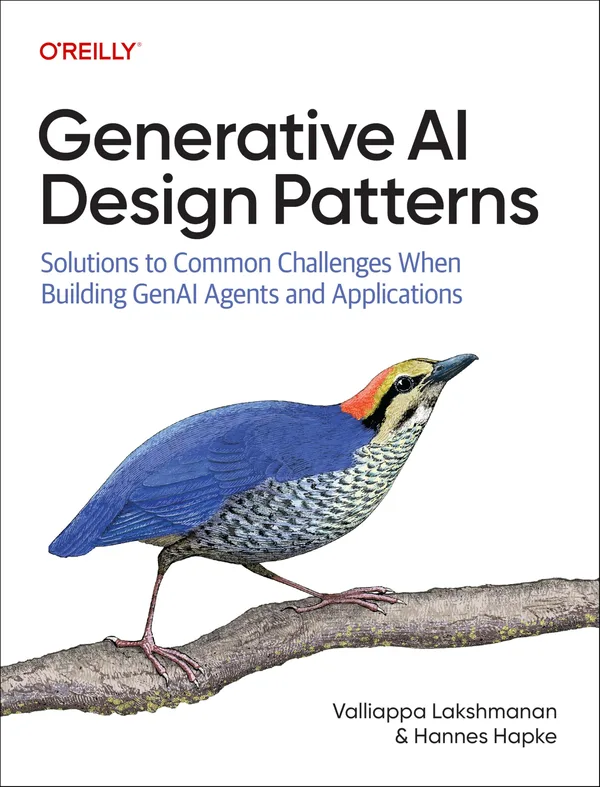
Lakshmanan co-wrote O'Reilly's Machine Learning Design Patterns in 2020. This October 2025 follow-up with Hapke applies the same format to generative AI across 508 pages and 32 patterns.
Each pattern states a problem, solves it with a fully coded example, then discusses the trade-offs. The chapters closest to prompting cover controlling content style and improving reliability, with patterns such as LLM-as-Judge, meaning one model grading another model's output, and Prompt Optimization. Later chapters move into agents and guardrails.
What sets it apart is that it reaches below the prompt when the prompt is the wrong tool. Its first pattern, Logits Masking, constrains which tokens the model is allowed to produce at all, and adapter tuning arrives a few chapters later. It is the one book here that will tell you, politely, to stop rewording the prompt.
It lands third on reach and focus. It is rated intermediate to advanced, and every pattern assumes you can read Python. Prompting also shares the book with retrieval and inference optimization among others. A reader who wants to get better at prompts will find the relevant patterns spread across several chapters, which is the price of a catalogue.
4. Prompt Engineering for Generative AI, by James Phoenix and Mike Taylor
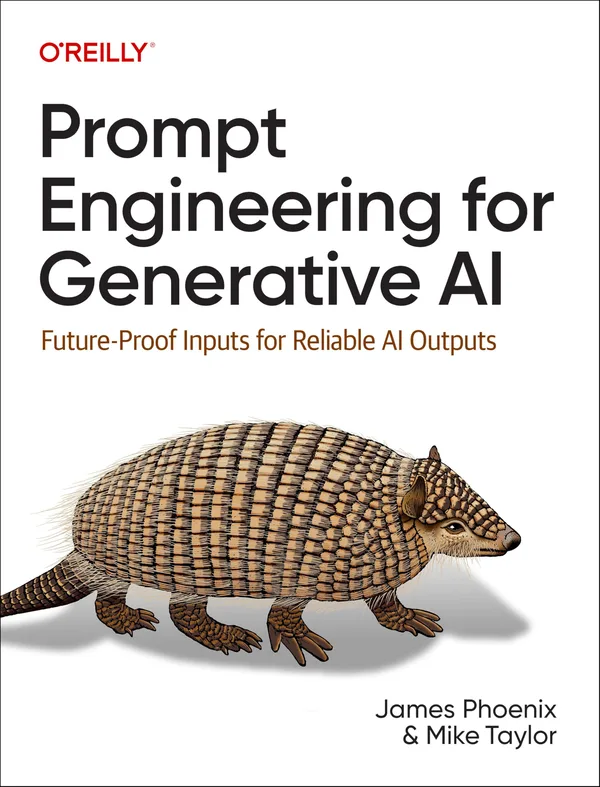
Phoenix has taught more than 60 data science courses at General Assembly and through his company, Vexpower. Taylor created the marketing agency Ladder. Their O'Reilly book came out in May 2024 at 422 pages, rated beginner to intermediate.
It opens with five principles of prompting, from giving direction to dividing labor, then applies them twice. Text generation runs through ChatGPT and LangChain, with chapters on vector databases and autonomous agents. Image generation gets three chapters of its own, on diffusion models and Midjourney among others.
What sets it apart is image prompting. Diffusion models, meaning image generators that build a picture by removing noise step by step, get more space here than in the other four books combined. The Midjourney chapter covers negative prompts and consistent characters among others. If your prompts end in pictures, this is the book with the most to say.
It lands fourth on currency. Much of its code is written against LangChain as it stood in early 2024, and a library that releases that often does not hold still for two years, so expect to translate examples as you go. Evaluation appears inside other chapters and never gets one of its own, which costs it on lifecycle coverage against all three books above it.
5. Unlocking the Secrets of Prompt Engineering, by Gilbert Mizrahi
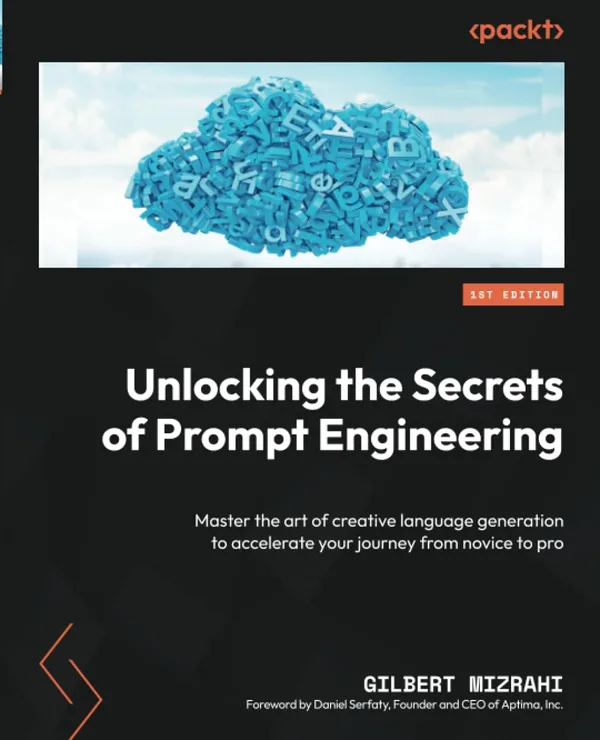
Mizrahi works in creative technologies and AI. His 316-page Packt book came out in January 2024, with a foreword by Daniel Serfaty, founder and CEO of Aptima.
It opens with the structure of a prompt, then spends most of its pages on applications. Content creation and creative writing come first, followed by chapters on education and law. A closing part turns to ethics and the limits of generative AI.
What sets it apart is that it is organised by job. A marketer who needs product descriptions, or a teacher planning lessons, can open the relevant chapter and start without reading any theory first. It is also the only book here whose podcast chapter covers promoting the podcast, which suggests the author has met podcasters.
It lands fifth on currency and lifecycle coverage. It was written for the ChatGPT of 2023, before tool use and agents changed what a prompt has to do, and no chapter is given to testing a prompt or keeping it working across model versions. It also explains little about why a model responds the way it does, so the techniques arrive as recipes without the reasoning behind them.
Which prompt engineering book to read first
The ranking says which book is strongest on the criteria. The table matches each one to the problem on your desk.
| If you are | Start with |
|---|---|
| Using AI in a non-technical job and want results this week | Unlocking the Secrets of Prompt Engineering |
| Writing prompts that end in images | Prompt Engineering for Generative AI |
| Building LLM features in Python and hitting the limits of prompting | Generative AI Design Patterns |
| Wanting to understand why a prompt works | Prompt Engineering for LLMs |
| Responsible for prompts that must keep working in production | AI Prompt Engineering |
Most people building with LLMs get the most from first and second place together, since one covers what happens to a prompt after launch and the other explains the model it is talking to. For agents specifically, Agentic AI Engineering takes system prompts and tool design further than any book on this list.
One book missed the list on timing. Prompt Engineering in Practice by Richard Davies and Rafael Fischer, from Manning, treats prompts as maintainable software through a four-phase lifecycle that runs from design to management, which is the ground first place stands on. Its ebook and print editions release on October 9, 2026, and we will revisit this ranking once we have read the final text.