

The best AI books for business in 2026 help a leader with the decisions AI now forces on a company, such as where it belongs and what it will really cost. Plenty of books explain what AI is. Far fewer help you approve or cancel an AI project with your eyes open, which is the part that shows up on the budget.
The five ranked here had to clear one bar: a founder or manager with no technical background should finish the book able to make a better call on a real AI initiative. Three were written after ChatGPT arrived and two before, and that difference matters more than the publication dates suggest.
If you already know which agents you want, our guide to the AI agents every business should build in 2026 picks up where these books stop.
How we ranked the best AI books for business
Every book was measured against the same four criteria, with the same weights. None got credit for its publisher or its price. The field is limited to books you can buy.
| Criterion | Weight | What it actually measures |
|---|---|---|
| Decision tools | 35% | Whether a leader can apply it to a real AI decision this quarter, through templates, checklists or worked numbers |
| Currency | 25% | How well it covers generative AI and agents as businesses buy them in 2026 |
| Evidence | 20% | How far its claims rest on published research or documented company cases |
| Accessibility | 20% | Whether a reader with no technical background can finish it |
Decision tools carry the most weight because a business reader buys these books to act on them. A brilliant argument that leaves you with nothing to bring to Monday's budget meeting scores lower than a plainer book that hands you a template. The featured Ashford Partners title was read in full; the other four entries draw on each publisher's listing and description.
1. AI Systems in Business, by Thomas Stewart
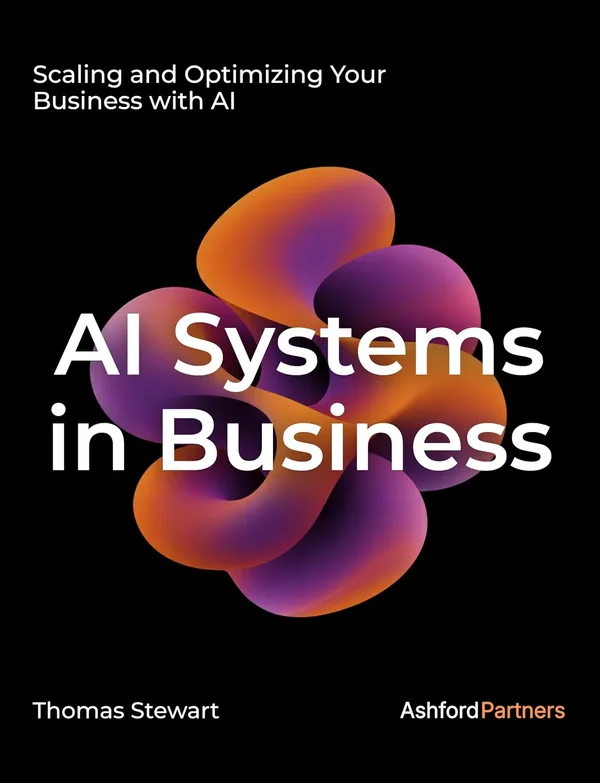
AI Systems in Business is an Ashford Partners title published on October 22, 2026, at 329 pages. Thomas Stewart, a consultant who builds AI workflows for companies, organises it as 40 short modules in seven chapters.
It follows one AI initiative from start to finish. The early chapters cover strategy and the choice of models, then agents and the economics of running them. Later chapters deal with security and staffing, and the last ones carry a system from pilot to production through to the decision to scale it or shut it down.
What sets it apart is that nearly every module ends in an instrument you can use, from a one-page project charter with kill criteria to a three-year cost-of-ownership table. Its private bake-off tests candidate models on 50 to 200 of your own cases and ranks them by cost per acceptable output, a figure no vendor price sheet shows. Its claims rest on roughly 110 cited studies, and the preface says the author would count talking you out of a project or two as money well spent. Few consultants put that in writing.
It wins on decision tools and currency, and gives ground on storytelling. Its evidence arrives as study results, so readers who learn through named company stories will find far more of them at fourth place. Competitive strategy gets one module where Iansiti and Lakhani give it a whole book, and the text reads like a dense manual. It is also a first edition from an author without a public track record, too new for reader reviews. For the engineering side of the same ground, see Agentic AI Engineering.
This book is published by Ashford Partners.
2. Co-Intelligence, by Ethan Mollick
Co-Intelligence came out from Penguin Random House in April 2024, at 256 pages, and became a New York Times bestseller. Mollick is an associate professor at the Wharton School, where he directs the Generative AI Lab.
It asks readers to treat AI as a co-worker and a coach, and it works through what that means for business and education using dozens of examples of AI in action.
What sets it apart is its focus on you, personally, working alongside AI. Mollick studies what these tools do to work and writes about it for a wide audience, which makes this the most readable book on the page. It is the one to hand a board member who has never opened a chatbot and is quietly hoping nobody notices.
The gap to first is decision tools. Its subject is the individual working with AI, so the questions a manager faces when buying and governing AI for a whole team get far less room. Published in April 2024, it also predates the agent products businesses are now being sold. Readers who mainly want to sharpen their own daily use should pick it over first place.
3. The AI Playbook, by Eric Siegel
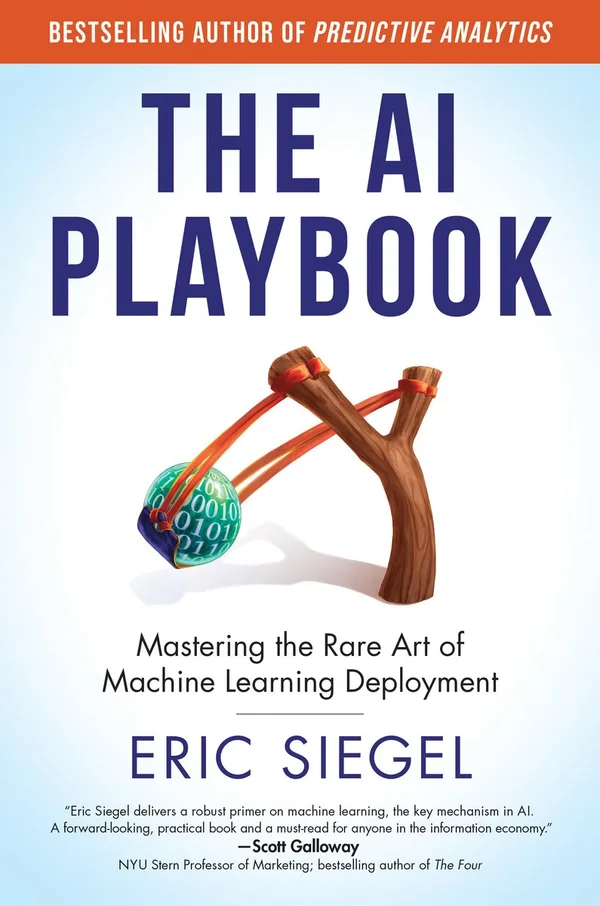
The AI Playbook was published by the MIT Press in February 2024, at 256 pages. Siegel is the bestselling author of Predictive Analytics.
It sets out a six-step practice for taking machine learning projects from conception to deployment, illustrated with case studies from UPS and FICO among others.
What sets it apart is that it writes for both sides of the table. It gives business readers enough semi-technical background to agree with the data team on what a model should predict and how its predictions will be acted on, which is where many projects quietly fall apart. Its premise, that machine learning projects routinely fail to deploy, will sound familiar to anyone who has watched a pilot vanish from the roadmap without a press release.
It lands third on currency. The author's own note says the book covers machine learning used to improve operations, the predictive kind, so generative AI and agents sit outside it. Its project discipline transfers to a language-model rollout; its examples and technical background do not.
4. Competing in the Age of AI, by Marco Iansiti and Karim R. Lakhani
Competing in the Age of AI was published by Harvard Business Review Press in 2020, at 288 pages. Both authors are professors at Harvard Business School.
It argues that rebuilding a firm around data and AI removes old limits on scale and scope among others, using companies such as Ant Financial and Amazon. It then explains the collisions between AI-driven firms and traditional ones, and the risks of changing an operating model.
What sets it apart is that it asks what AI does to the shape of the firm itself. The other four books start from a project or a person; this one starts from the operating model, and it draws on research in hundreds of firms.
It lands fourth on currency. Published in 2020, it predates ChatGPT, which in AI years places it somewhere near the Bronze Age. Its argument still holds, but it offers little to a manager choosing a first project or pricing a vendor, so it scores low on decision tools.
5. Power and Prediction, by Ajay Agrawal, Joshua Gans and Avi Goldfarb
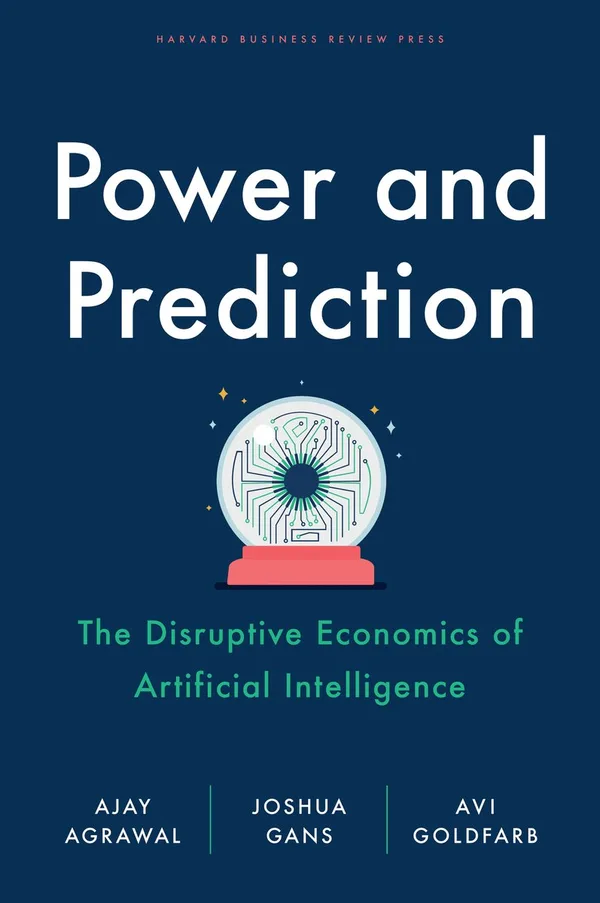
Power and Prediction was published by Harvard Business Review Press on November 15, 2022, at 288 pages. It is the authors' follow-up to their bestseller Prediction Machines.
It takes the decision as its unit of analysis, which it splits into prediction and judgment. Its argument is that the big gains come from redesigning whole systems of interdependent decisions.
What sets it apart is that it explains why. If you have watched an AI tool bolted onto one step deliver almost nothing, this is the book that tells you the system around the step was the problem, and it frames who wins and loses when those systems change.
It lands fifth on decision tools and currency. It went on sale fifteen days before ChatGPT launched, so its examples come from predictive AI, and its economist's lens gives you a way of thinking with few tools for Monday morning. Leaders setting long-range strategy may rank it higher than this page does.
Which AI book should a business leader read first?
The ranking answers which book is best overall. This table answers which is best for you.
| If you are... | Start with |
|---|---|
| About to approve, budget or run an AI project | AI Systems in Business |
| New to AI and want to change how you work first | Co-Intelligence |
| Leading a predictive analytics or data science project | The AI Playbook |
| Rethinking your company's operating model | Competing in the Age of AI |
| Setting long-range strategy and want the economics | Power and Prediction |
Whichever you pick, test its ideas on one process you know well before you scale anything, ideally a high-volume step where AI business process automation is cheap to check. Once a system is live, our guide to AI governance business context refinement covers keeping it under control. For technical reading, see the best AI books for engineers and builders.