
Jev AI is a model from TypeSafe AI that answers machines. You hand it some program state and a typed question, and it hands back a decision with a probability attached, in about a tenth of a second. It never writes a sentence.
That sounds like a downgrade until you count how many points in your software actually needed a sentence. Routing a support ticket does not. Deciding whether a tool call is safe to run does not. Those places have been paying a language model to compose prose that a JSON parser immediately throws away.
TypeSafe calls this class of model a System One model, after the fast automatic half of human thinking. Jev is the first one, available in early access through a hosted API since September 2026.
What a system one model actually is
A system one model is built to make one fast structured decision that software can consume directly.
The name borrows from the split between fast intuitive thinking and slow deliberate reasoning. Chat models and reasoning models live on the slow side. They think out loud, at length, and charge you per word of the thinking.
The fast side is the one that recognises a face or slams the brakes. No narration, no chain of thought, an answer arriving before you notice producing it.
Jev sits there. TypeSafe describes the model as a frontier-intelligence function call: unstructured state in, typed probabilistic decisions out. The input is the same messy mixture a chat model takes, with an emphasis on structured program state. The output is a value your code already has a type for.
The practical consequence is that the model stops being a conversational partner and becomes a subroutine. You never prompt it to respond with valid JSON and nothing else. It has no other mode to fall back into, which spares everyone the familiar ritual of a reply that opens with "Certainly! Here is the JSON you requested:" and breaks the parser two lines later.
How Jev works without generating text
Jev produces its answer in a single forward pass, with no token-by-token generation at all.
Standard language models are autoregressive, meaning they emit one token at a time and feed each one back in before choosing the next. A twenty-token JSON object costs twenty sequential trips through the network. None of that loop parallelises, which is why latency scales with output length and why even the special tokens that frame every chat reply cost measurable time.
Jev drops the loop. TypeSafe uses parallel sampling, so every question attached to a state is answered in the same pass and a request carrying eight questions costs close to what one costs. The company reports end-to-end response times of 70ms to 500ms, against 3 to 329 seconds for the chat models in its comparison.

The training objective differs as well. TypeSafe calls it Reinforcement Learning for Calibrated Decisions, a cousin of the reinforcement learning from human feedback that shaped chat models, tuned so the probabilities the model reports match how often it turns out to be right. A 0.9 from Jev is meant to be correct about nine times in ten.
Calibration is the quiet part that matters most. Ask a chat model for a confidence score and it will cheerfully produce 0.95, because 0.95 looks like a confident number, having learned to sound certain the way a horoscope learns to sound specific.
When the number is honest, your code can branch on it. Act on the confident answers, escalate the rest. That one behaviour is what turns a model into a component you can reason about.
What a classifier model returns: choice, score and noul
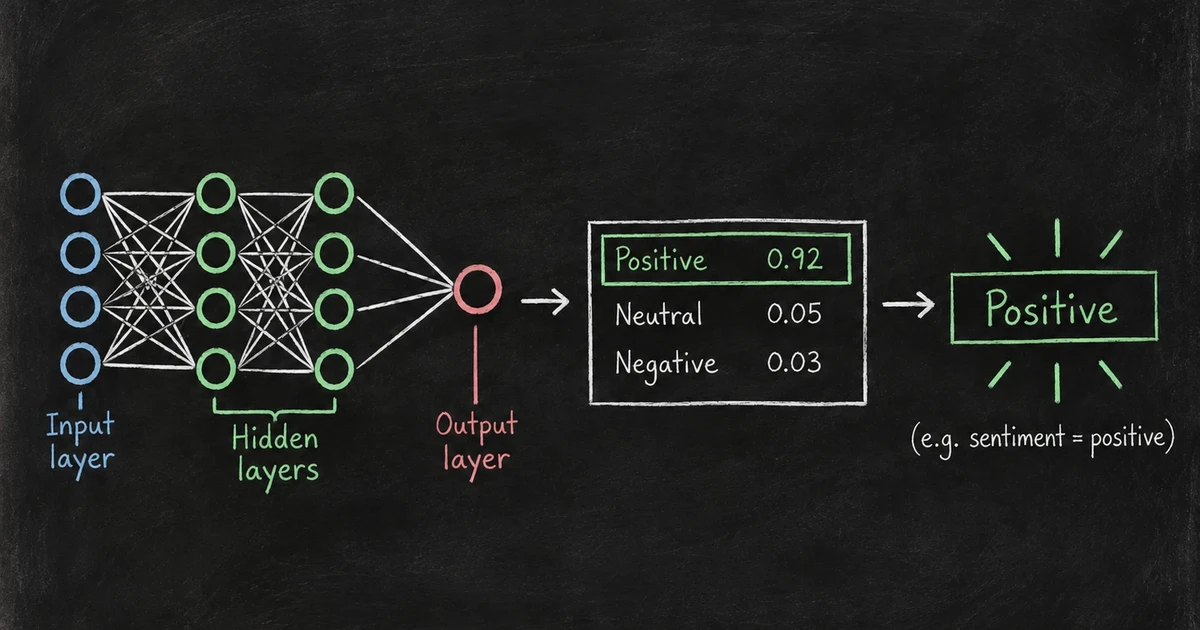
Jev takes a state and a set of typed questions about it, then returns one answer per question with probabilities attached.
There are three question primitives, and they are worth learning as a set, since most decisions inside an application collapse into one of them:
| Primitive | What you ask | What comes back |
|---|---|---|
| Choice | Select one option from a defined set | The selected option, with a probability for each option |
| Score | Rate the state against ordered, described levels | The score, with probabilities across the levels |
| Noul | A yes or no question | The probability that the answer is yes |
A noul answer arrives as "is_urgent": {"type": "noul", "noul": 0.999}. No prose, no wrapper, nothing to strip.
Because you supply the options, the model cannot return one you did not define. TypeSafe leans on this and says the model never makes type errors, which is true and narrower than it first sounds. Jev can still pick the wrong option from your list. What it cannot do is invent a nineteenth category or hand your parser a string where an enum belongs.
Cardinality caps at 255 choices per question, which keeps this a decision model. Naming the correct row out of a million stays a retrieval problem.
Anyone who has built a classifier the traditional way will find this familiar, and the evaluation discipline carries straight over. A typed decision is still a prediction, so it earns the same precision and recall treatment any classifier gets.
Where Jev fits in an AI automation pipeline
The natural home for a decision model is the branch points inside an AI automation pipeline you already run, with a language model still doing the open-ended work around them.

LangChain's integration exposes Jev as a classifier you invoke with a state and a list of questions, and the pattern in their write-up on building an agent harness is the one to copy: keep the language model for reasoning and drafting, and give every branch in the graph to the decision model.
The uses that come up first:
- Model routing. Classify an incoming request and send the easy ones to a cheaper model.
- Guardrail middleware. Check a proposed tool call for risk and block it before it executes.
- Triage. Score a ticket or an alert against a rubric and escalate on the score.
- Map-reduce over a corpus. Ask the same question of a hundred thousand documents in an afternoon.
The economics carry the argument. Input runs at $0.042 per million tokens with output free, against $2 and $12 per million for the frontier chat model TypeSafe benchmarked against. Work that was uneconomic at a hundred thousand calls a day turns into a rounding error.
Guardrails deserve a straight note. A model that blocks risky tool calls is a safety control, and a control that fails open is worse than no control at all. Gate on the reported probability, log every block, and keep a human path for anything the model refuses. The speed is what makes the check affordable on every call. It does not make the check correct.
None of this removes the design work. Deciding which calls an agent may make and what happens when one is refused is the tool-design problem at the centre of agent engineering, and a faster gate does not answer it for you. The same pattern runs through the agentic AI use cases that reached production, where the boundary mattered more than the model.
What Jev cannot do
Jev cannot reason at length, and it cannot tell you why it chose what it chose.
The single forward pass that buys the speed also removes test-time compute, the extra thinking a reasoning model spends before it answers. Engineer Sean Goedecke's assessment of the launch is that this probably caps a model of this shape around the strength of a non-reasoning LLM. Fine for routing. Thin for judgement calls that need a real chain of thought.
He makes a sharper point as well. Fast structured output was already reachable by prefilling a response and constraining generation to a single token, so whether Jev is a new computational primitive or a well-packaged inference strategy remains open. The comparison runs against models forced to emit a JSON blob token by token.
Then there is explainability. Jev returns a decision and a probability with no linguistic account of either. In a support router that is fine. In anything that has to answer to an auditor, a number with no reasoning attached is a conversation you will be having later, at a worse time, with someone holding a printout.
Worth keeping in view: the headline figures of 193.6x faster and 444.6x cheaper come from TypeSafe's own evaluation, measured against the average of two frontier models, and the company says plainly that those sit at the higher end of real-world gains.
When to reach for a decision model
Walk your pipeline and find every model call whose output gets parsed and discarded. Those are the candidates.
A call belongs on the list when:
- The answer belongs to a small fixed set you can enumerate.
- The call runs often enough that latency or cost shows up on a dashboard.
- You would act on a confidence number if you trusted one.
- Nobody downstream reads the prose.
Three of four makes a strong case. Four of four and you are paying a novelist to fill in a form.
Where you go next depends on which half interests you. The machinery underneath, meaning why autoregression costs what it costs and what a forward pass is doing, is the subject of LLM Systems Engineering. The rest is a question your own traffic logs can answer in an afternoon, which is more than most architecture decisions can say for themselves.