

The best LLM fine-tuning books in 2026 share one goal: getting you from a base model that almost does what you want to a model that does it every time. Fine-tuning is the part of LLM training most teams will touch. Few of them will pretrain a model. Plenty will adapt one, usually on a single GPU, with a dataset somebody assembled on a Friday afternoon.
The hard part comes before the code. Deciding whether your problem needs fine-tuning at all, and which kind, saves more money than any learning-rate trick. If you are still weighing that, our guide on when to build an LLM covers the budget side.
The five books below run from first place to fifth. Each entry says what the book does that the other four do not, and where it stops.
How we ranked the best LLM fine-tuning books
Every book was scored on the same four criteria with the same weights. Publisher and price earned no credit. The field is limited to books you can buy.
| Criterion | Weight | What it actually measures |
|---|---|---|
| The adaptation decision | 30% | Whether it helps you decide if fine-tuning is the answer, and which kind, before you spend GPU hours |
| Data and evaluation | 30% | How well it prepares training data and checks the tuned model for forgetting and regressions |
| Runnable code | 25% | Code you can run on one GPU and adapt to your own dataset |
| Currency | 15% | How much of it matches the methods teams use in 2026, LoRA and QLoRA among others |
The decision and the data share the top weight because that is where fine-tuning projects fail. A model trained on the wrong problem, or on badly formatted examples, disappoints however tidy the training loop is.
1. LLM Systems Engineering, by Rob McKinsey
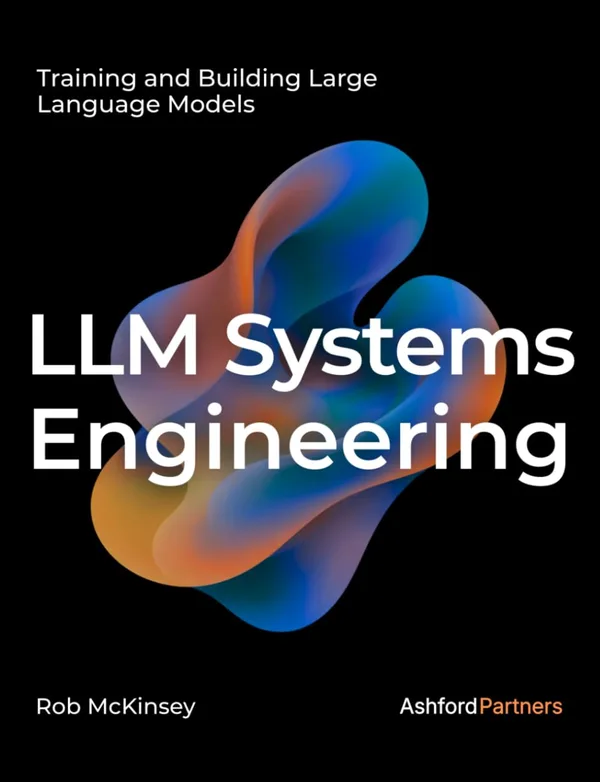
LLM Systems Engineering is a 359-page Ashford Partners title from 2026, organised as 42 modules in eight chapters. It follows a training project in the order you would run one.
Fine-tuning and continued pretraining each get a full chapter. Continued pretraining means further training a model on raw domain text so it learns what it lacks. Both chapters end in a runnable Unsloth recipe for Llama 3.1 8B in 4-bit on a 16 GB GPU. The data module covers chat templates and response-only loss masking, among others.
What sets it apart is the decision that comes before any code. McKinsey sorts problems by the gap you are trying to close. A behaviour gap, where the model knows enough and answers in the wrong form, points to fine-tuning. A knowledge gap points to continued pretraining, a case no other book here gives a chapter of its own. Training from scratch is rarely the right call. The book talks you out of training runs about as often as into them, which is the cheapest advice in this article.
It lands first because it wins both of the heaviest criteria. Its weak spot is hands-on depth past supervised fine-tuning. Preference tuning with DPO is explained without code. The recipes are 200-step demos checked with a smoke test, and a third of the book covers pretraining, which fine-tuners may skip. For preference tuning, see second place.
This book is published by Ashford Partners.
2. LLM Engineer's Handbook, by Paul Iusztin and Maxime Labonne
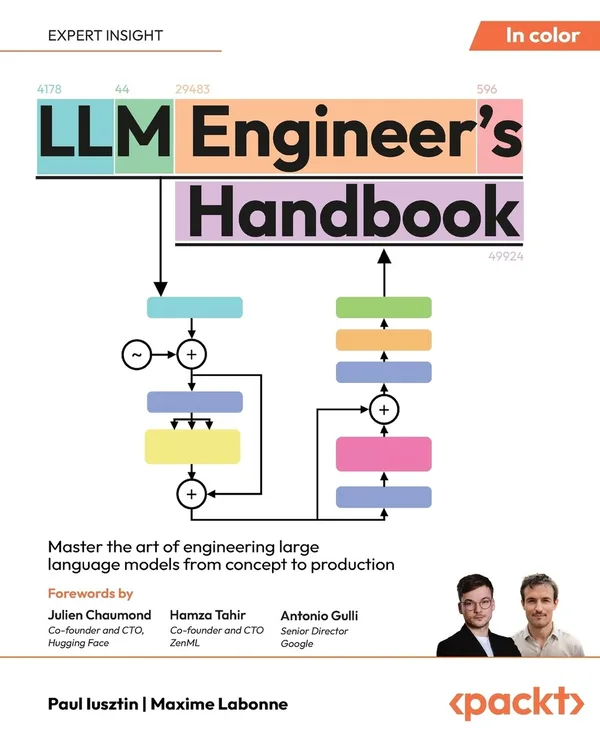
Iusztin and Labonne published the LLM Engineer's Handbook with Packt in October 2024. It runs 522 pages, is pitched at intermediate to advanced readers, and assumes you are comfortable with Python and AWS.
The book builds one project end to end, an LLM Twin that writes in your own style. Along the way come chapters on data engineering and a RAG feature pipeline. Then two chapters on training: supervised fine-tuning, and fine-tuning with preference alignment. Evaluation and inference optimisation close it out.
What sets it apart is the preference-alignment chapter. Preference tuning is the step after supervised fine-tuning, where the model learns which of two answers people prefer, and this is the one book here that gives it a full chapter of its own. Building a digital twin of yourself is also the fastest known way to discover how often you write "basically".
It lands second on the adaptation decision. Fine-tuning is two chapters inside a 522-page LLMOps build, so the question of when to tune, and what to do when the gap is knowledge, gets less room than the pipeline around it. The AWS-heavy setup also asks for an account and some patience before the training chapters pay off.
3. A Hands-On Guide to Fine-Tuning Large Language Models, by Daniel Voigt Godoy
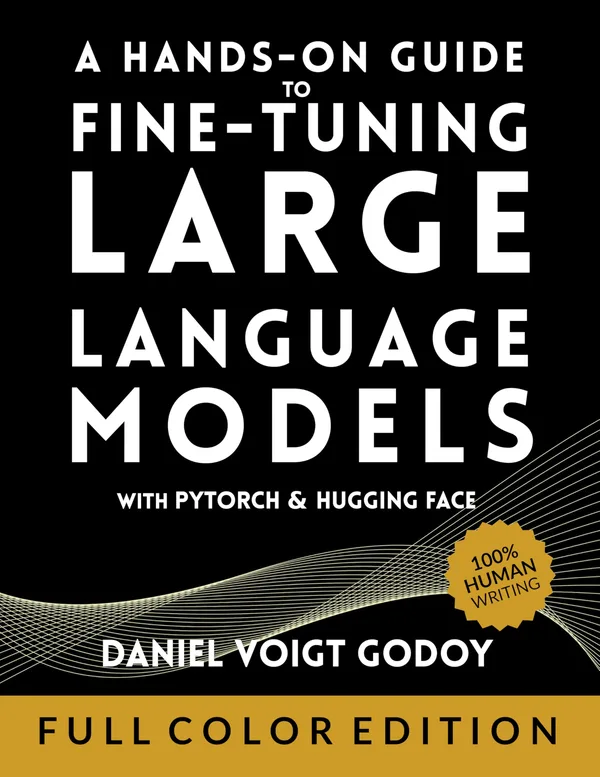
Godoy teaches at Data Science Retreat in Berlin and wrote Deep Learning with PyTorch Step-by-Step. His fine-tuning guide is self-published on Leanpub, where the revised edition came out in October 2025, and it assumes you already know PyTorch and Hugging Face.
It is the most direct route here from a base model to a tuned one on your own GPU. Each chapter adds one layer of the stack:
- Quantization with BitsAndBytes
- LoRA adapters with Hugging Face PEFT
- Dataset formatting and chat templates
- Training with SFTTrainer, Flash Attention 2 included
- Local deployment through GGUF and Ollama
What sets it apart is focus. There is no detour into pipelines or cloud platforms, and a troubleshooting chapter, numbered minus one, collects the errors you will meet, out-of-memory among them. It is the closest thing on this list to a colleague who has already broken everything you are about to break.
It lands third on the adaptation decision and on evaluation. The opening chapter surveys the types of fine-tuning, and the rest assumes you have already decided to fine-tune. Its table of contents has no chapter on evaluating the tuned model, and preference tuning appears as a concept with no hands-on chapter. On runnable code, the 25% criterion, it beats both books above it.
4. Hands-On Large Language Models, by Jay Alammar and Maarten Grootendorst
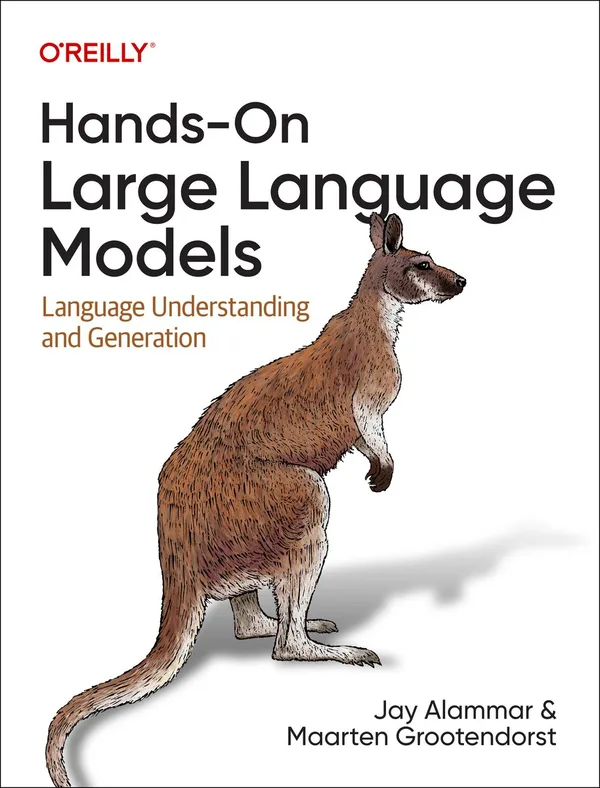
Alammar and Grootendorst published Hands-On Large Language Models with O'Reilly in September 2024. It runs 428 pages, is pitched at beginner to intermediate readers, and explains most ideas with diagrams, in the style of Alammar's Illustrated Transformer posts.
The first two parts cover using models: tokens and embeddings first, then tasks like classification and semantic search, among others. Part III turns to training in three chapters. The first two train embedding and classification models, and the last fine-tunes generation models.
What sets it apart is that it makes the concepts visible. Embeddings and attention are drawn before they are coded, so a reader new to the field understands what a fine-tune changes before running one. Its chapter on training embedding models also helps when retrieval is the weak link in your system. The diagrams are good enough that you may catch yourself explaining attention to people who did not ask.
It lands fourth on the adaptation decision and on data. Fine-tuning is three of twelve chapters, and the book's centre of gravity is using models. You finish knowing what fine-tuning does, with a working example behind you, and you will want one of the books above before you plan a production run.
5. Build a Large Language Model (From Scratch), by Sebastian Raschka
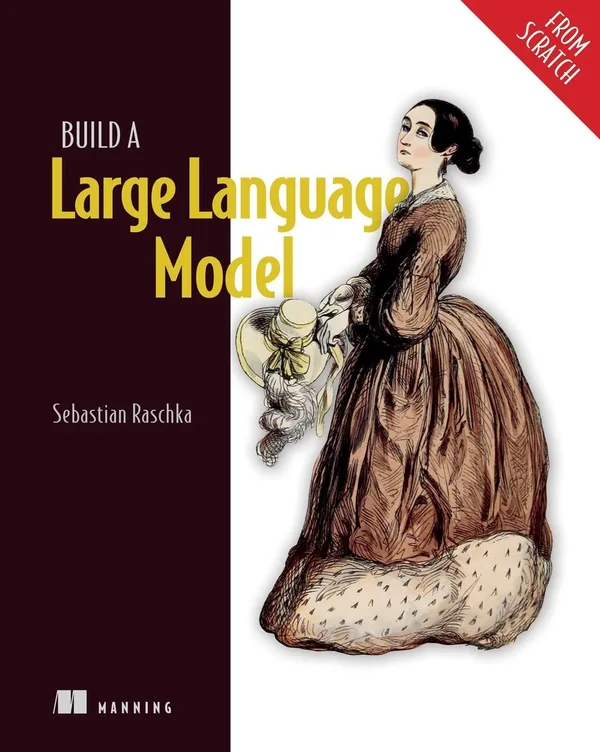
Raschka's Build a Large Language Model (From Scratch) came out from Manning in September 2024 at 368 pages. You code a GPT-style model in PyTorch, pretrain it, then fine-tune it twice.
Chapter 6 fine-tunes the model to classify spam, and chapter 7 tunes it to follow instructions, with the dataset formatting written by hand. An appendix adds LoRA, meaning training a small set of added weights while the original model stays frozen.
What sets it apart is that nothing in the fine-tuning is hidden. There is no trainer class and no adapter library, so you see the loss masking and the label shifting in code you wrote yourself. When your instruction-tuned model answers a question about pasta with a haiku, you will know exactly which line to blame.
It lands fifth on currency and on the adaptation decision. The models are GPT-2 scale, and the tooling teams use in 2026 does not appear. Nor does any guidance on when fine-tuning is the right call. Read it to understand what a fine-tune does to the weights, then pick up one of the four above to do it on a real model.
Which LLM fine-tuning book to read first
The ranking says which book is strongest on the criteria. The table matches each one to the problem on your desk.
| If you are | Start with |
|---|---|
| Deciding whether fine-tuning is the right call | LLM Systems Engineering |
| Adding preference alignment to a production pipeline | LLM Engineer's Handbook |
| Fine-tuning an open model on your own GPU this month | A Hands-On Guide to Fine-Tuning Large Language Models |
| New to LLMs and wanting the concepts drawn out | Hands-On Large Language Models |
| Wanting to see every line of a fine-tune | Build a Large Language Model (From Scratch) |
Most engineers should read first place, then add third place for the code. Once a tuned model heads for production, our guide to LLMOps covers what happens after training. Readers who want agents and prompting under the same cover as model training can look at Ashford's combined AI Engineering volume.